

The United States has undergone several distinct phases of immigration throughout its history. These include migration from Europe to the US, which began in the 16th century and continued through the 20th century. Then there was the westward migration, which began in the 18th century and arguably continues to this day. Finally, over the last half-century, there has been a mass migration of people from Central and South America to the United States. Then there was the Great Migration, the movement of Black Americans from the South to the North in the 20th century.
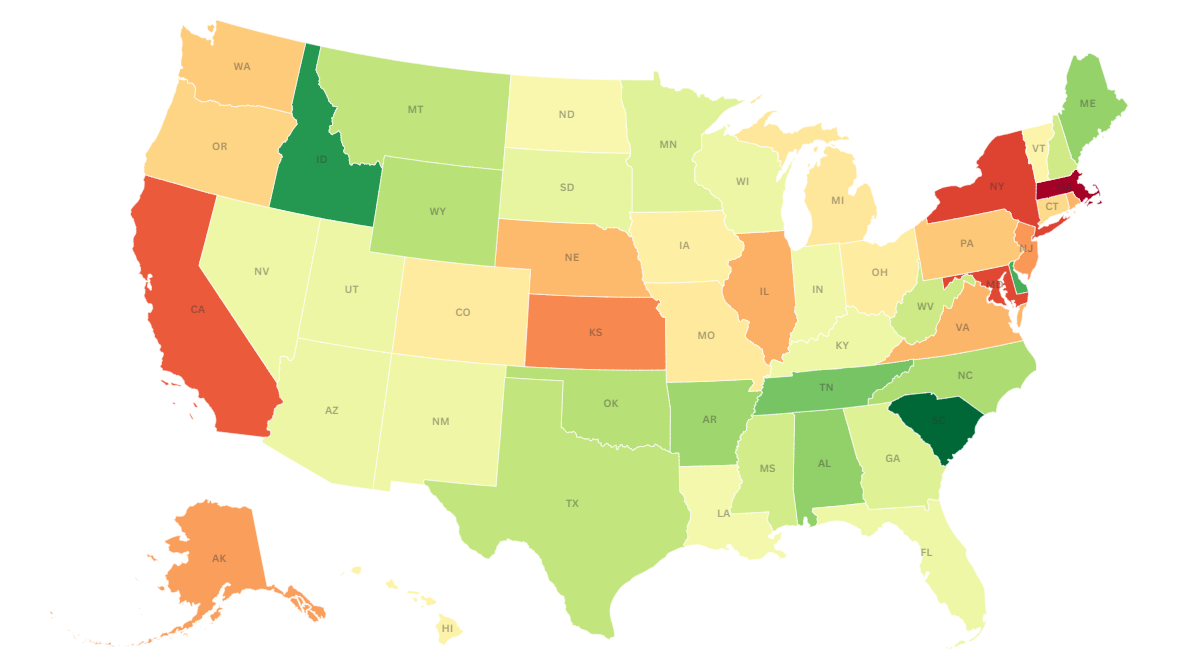
Over the last few years, however, a new migration trend has begun, a movement south. The above map, provided by HireAHelper, tells the story of 2025. States that are red have more people moving out than moving in. States that are green have more people moving in than moving out. The Northeast is seeing outmigration at a prodigious rate. Massachusetts, despite being home to the world’s best universities and one of America’s most popular cities, is losing people at a faster rate than any other state. The Midwest is treading water, with states like Illinois losing people while Minnesota is gaining. Then there’s the West Coast. Washington, Oregon, and California used to add people at a fast clip. From the days of the Oregon Trail, Americans would head westward looking for a better life. Today, however, the trend has reversed. Fewer people are moving in than moving out in all three states.
On the opposite end of the spectrum is the Southeast. The part of the country traditionally seen as somewhat of a backwater outside of a few cities like Atlanta has suddenly become a magnet for Americans on the move. Consider the traditional Southeast: North Carolina, South Carolina, Georgia, Florida, Alabama, Mississippi, Louisiana, Arkansas, and Tennessee. All nine of these states had a net migration gain in 2025. No other region has such consistency over so many states. Even in the aforementioned Northeast, in which most states had a net migration loss, New Hampshire and Maine bucked the trend and gained residents. In the Southeast, however, there isn’t a single exception to the rule. And not only did all gain residents, but most did at a significant rate. North Carolina gained about 29 residents per 10,000. Tennessee, 43.6. The biggest winner, however, was South Carolina, which gained a massive 79.7 residents per 10,000 in 2025, more than any other state. Only sparsely populated Idaho, which gained 63.2 residents per 10,000 people, comes close.
It’s worth noting that geographic trends in the US population have been remarkably consistent since World War II. One of my favorite stats is the “Mean Center of Population for the United States”, that is, the point around which an equal amount of Americans live. This has been tracked since 1790, and is displayed on the below map:
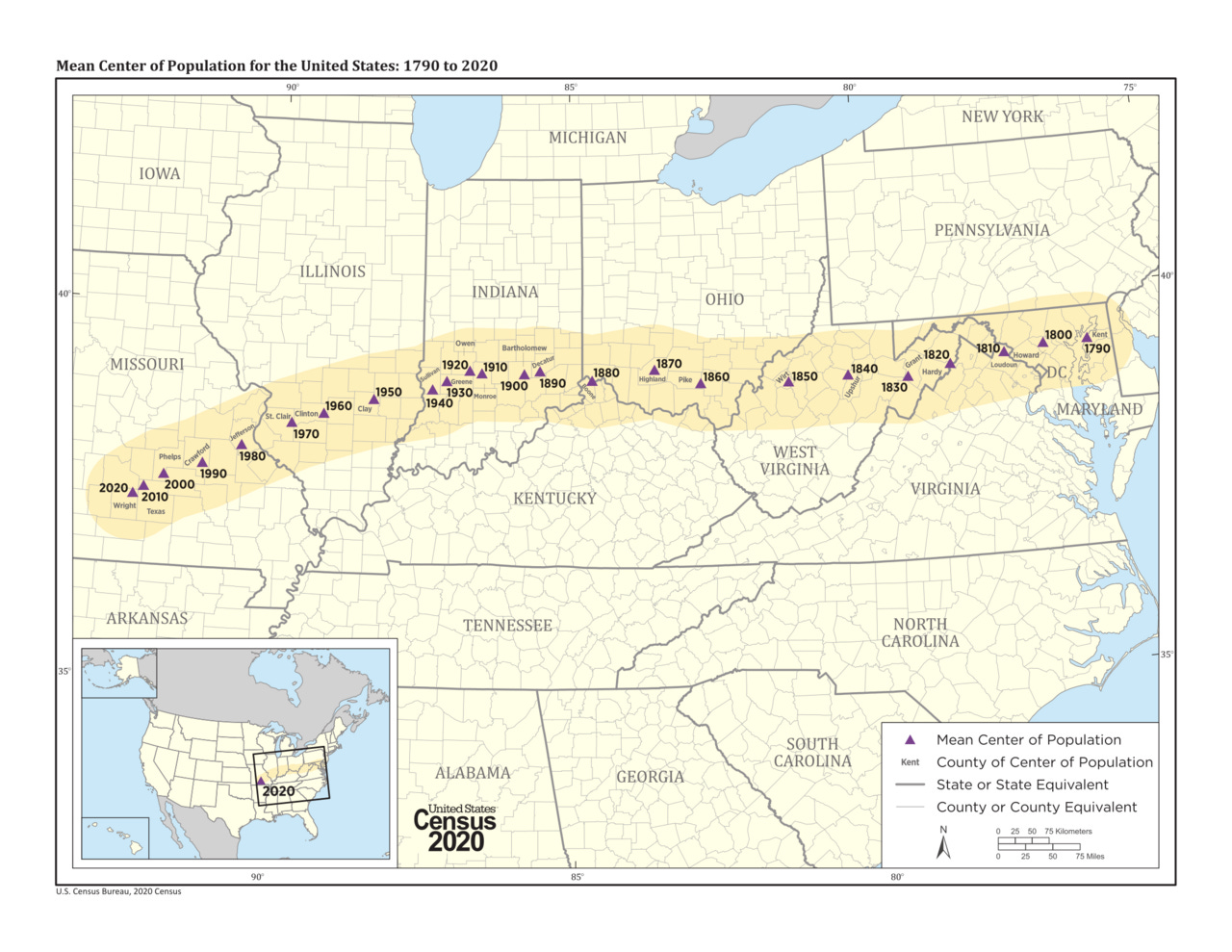
Every single census, from 1790 to 2020, has shown a population that is moving west. In the 19th century, Americans flocked westward as fast as they could. Then, during the World Wars and Great Depression, the westward drift slowed markedly. Since World War II, the population of America has continued its westward movement, but has also begun to move steadily south. Now, this is not just because of people moving. Births and deaths play a greater role than migration when determining the mean center of population. Still, given that southern states generally have higher birth rates than states on the West Coast and in the Northeast, it is possible that for the first time in US history, there is no westward trend to the population. The 2030 census could be a watershed moment.
So, what is behind the migration to the southeastern United States? There are likely a few reasons.
The first, as those on conservative social media like to constantly mention, is government. The top 10 states for net migration gain on a per capita basis are South Carolina, Idaho, Delaware, Tennessee, Alabama, Maine, Arkansas, North Carolina, Oklahoma, and Wyoming. Eight of those 10 have Republican control in both houses of the state legislature, and the same eight voted for Trump in 2024. Eleven and twelve on the list are Montana and Texas, so this isn’t a cherry-picked stat. The 10 biggest net migration losers are Massachusetts, New York, Maryland, California, Kansas, New Jersey, Alaska, Illinois, Rhode Island, and Virginia. Eight of those 10 states have Democratic control across both houses of the state legislature, and the same eight voted for Harris in 2024. Looking across states, it’s striking that regardless of region, people are leaving Democratic states and moving to Republican ones. Virginia, for example, is the one traditional southern state that is still blue. It is also the only southern state that had a net migration loss in 2025. New Hampshire and Maine, meanwhile, are the only states in New England that are gaining population. They are also the two most conservative. Idaho has the second-largest net migration gains and is one of the most right-leaning states in the US, having voted for the Republican presidential candidate in every election since the 1964 trouncing of Barry Goldwater by Lyndon Johnson.
The more interesting question, however, is what policies are Democrats enacting that drive people away? The primary one is housing. This is beginning to shift as more and more people move south, but housing in blue states costs more than housing in red states. Entire regions of the country had effectively priced out middle-class Americans. California and New York, the two biggest engines of American growth, have become unsustainably expensive. People can moan all they want about geographic restrictions caused by the ocean and mountains and national parks, but the reality this is a political decision. Manhattan has a population density of roughly 70,000 people per square mile, and it’s one of the most sought-after places to live in the world. Contrast the Big Apple with San Francisco, which has a population density of roughly 17,000 people per square mile. Clearly, far more housing could be built in the Golden State, but the government has made it functionally illegal to do so. As a result, people have moved south. Today, however, the housing gap has narrowed. Now that some southern cities like Charleston, SC, have become as expensive as their northern peers, it will be interesting to see if the southern migration trend lessens.
Another factor is climate. It may seem odd, but the full effects of air conditioning are still being adjusted for in housing decisions. Even in the 1990s, a significant portion of homes and businesses in the South did not have air conditioning. The air conditioning they had was often substandard. For northerners, this alone was enough to make living in the deep south untenable. Today, however, almost all homes and businesses have AC, and the AC they have is frequently Arctic. The presence of near-universal air conditioning has removed one of the biggest downsides of living in the American South. People are responding and beginning to move there.
It will be interesting to see what the next decade holds. If housing prices continue to stay elevated in the north and remote work continues to be a viable option for many white-collar workers, it is likely the popularity of the Southeast will continue. If the trend accelerates, we could see the end of the longest migration trend in the country’s history: westward migration.