


The rich don’t pay taxes.
It’s a totem recited again and again. People post it online, discuss it with Ezra Klein, and make YouTube videos that hit one million views. Almost as if saying it enough times will make it come true.
It isn’t.
The idea the rich don’t pay taxes is a total shibboleth, right up there with “public schools are underfunded” and “Americans don’t care about senior citizens”. The rich do pay taxes. Not only do they pay taxes, but they pay a lot in taxes. Proportionally, rich Americans pay a higher percentage of taxes collected than just about any other country.
The United States is relatively unusual in that there isn’t a national sales tax. If you buy a steak dinner at a restaurant or a sweatshirt at a store, the federal government doesn’t see a dime. In most other wealthy countries, this would trigger a value-added tax (VAT), which is similar to a national sales tax. Such taxes are often regressive, in that lower income individuals have to pay a higher percentage of their income. Instead, the US, especially the federal government, relies heavily on personal income taxes. Most countries have some sort of personal income tax, where people pay a direct tax not on what they buy, but on the money they earn. These systems are usually designed to be progressive. Not progressive in the political sense, but progressive in an economic sense. That is, the rich pay more. Not only more in dollars and cents, but more proportionally.
Consider a few simple examples. A single American who made $25,000 last year would pay about $900 in personal income tax. Social security and Medicare (FICA) add another $1,913. Across income tax and FICA, that’s a tax rate of 11.3 percent. Which is fairly low. Making $25,000 a year as a single adult is lower-class, but isn’t living in poverty. Especially for those living in areas with robust welfare programs, life would be adequate, albeit not particularly pleasant. Importantly, someone in this situation keeps 89 percent of their income.
Let’s say our individual making $25,000 a year gets a raise that doubles their income to $50,000. What happens to the taxes owed? They more than double. Income tax increases to $3,871. FICA to $3,825, for a total of $7,696. Income doubled, but taxes due almost tripled. Combined, our worker’s effective tax rate is now 15.4 percent. Our worker is now firmly in the middle class, and still keeps about 85 percent of their earnings.
Now let’s say our individual gets their dream job and gets a raise from $50,000 to $200,000. They have graduated from the middle class to the upper class. Great job! But their taxes increase a tremendous amount. Personal income taxes are now $37,067. FICA is $13,818. Total federal taxes paid are now $50,885, for an effective tax rate of 25.4 percent.
For an individual who goes from $50,000 a year and the middle class to $200,000 a year and the upper class, taxes paid go up by a factor of 6.6. A quadrupling of income leads to a more than sextupling of taxation. None of this is necessarily unfair. But it is inaccurate to say the rich don’t pay taxes, when someone who is upper class pays a significantly higher percentage of their income than someone who is middle class.
Because the United States relies so much on income tax, this leads to a highly progressive system. Europe, with its high national sales tax, disproportionally taxes the poor and the middle class, who have to spend a higher percentage of their income on consumption. Now, those same people get the taxes they pay back in terms of the vaunted European social safety net we always hear about. But they are paying for that privilege, and paying a lot. The European middle class gets hit especially hard. An American who makes $50,000, someone firmly in the middle class, only pays $7,696 in income tax and FICA. A Dutchman, on the other hand, who makes €50,000 a year, a middle-class Dutch salary, would pay €18,056 in taxes, over double the amount of an American.
Again, there are plenty of other factors at play. The Dutch have a robust social safety net. There are other taxes that need to be considered as well. The US has state income and sales tax in most states. The Dutch have a high value-added tax. But from an income perspective, the differences aren’t even close. The Dutch middle class pays far more in taxes than the American middle class. The American rich pay a much larger share of taxes than the rich in other countries. Just look at this chart:
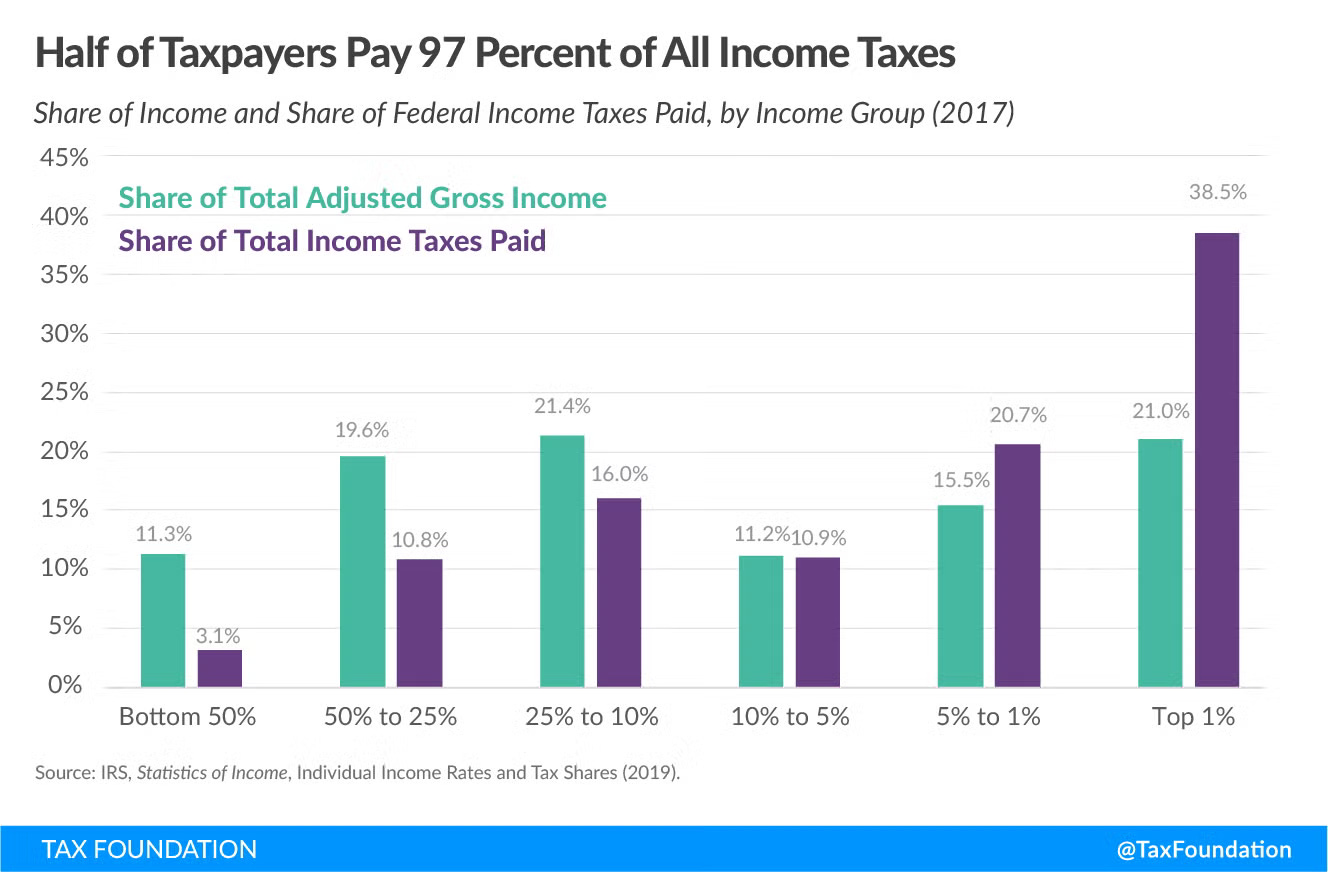
The top one percent, that is, just one out of every 100 people, singlehandedly pay 38.5 percent of all income taxes! That one person pays more than the bottom 90 people combined. This is not to argue that this taxation is unfair. That one person also makes over a fifth of the total adjusted gross income, a tremendous amount. The point is that it is untrue to say the rich don’t pay taxes. They not only pay taxes, they pay a lot.
So why is there such a disconnect? Why do people claim the rich don’t pay any tax when the statistics say they do? A few reasons. First, organizations like ProPublica run a disingenuous series of articles titled “The Secret IRS Files” and “Trove of Never-Before-Seen Records Reveal How the Wealthiest Avoid Income Tax”, using stolen tax documents. They correctly document that in some years, the richest Americans have paid very little in income tax. In some cases, zero dollars. That income tax is then compared to how their wealth has grown to calculate a “True Tax Rate”.
It is not a true tax rate.
First, to figure out a “true tax rate”, one must know how much someone paid in tax. ProPublica does not know this information. ProPublica knows how much these individuals paid in income tax, but not how much they paid in things like property tax, let alone sales tax. So their true tax rate is based on only a partial accounting of how much they have paid in tax.
Second, their “true tax rate” is calculated based on their increase in wealth, which is an irrelevant concept when it comes to taxation in America. Wealth is not taxed. Income is taxed. Capital gains are taxed. But if you bought $1,000 in Bitcoin in 2013, and it’s now worth $1,000,000, that isn’t taxed. Nor should it be. After all, you haven’t made any money yet. That $1,000,000 wealth is just a digital asset. Once the bitcoin is sold, then the $999,000 in gains is taxed. That’s how it works for everyone.
This is all very frustrating because there are good arguments for raising taxes on the wealthy. The top income tax rate, which is currently 37 percent and begins for those making $626,351, could be raised to a higher rate at a lower income. Make the top tax rate 40 percent have it begin at $300,000. No complaints here - although many who make $300,000 will shamelessly claim to be middle class and plead poverty. Inheritance tax also needs to be completely overhauled, so that the wealthy can no longer buy-borrow-die and bequeath their riches to relatives without paying tax.
To make this happen, however, we need to have an honest conversation about where taxes come from. We need to make clear that yes, there are a few very high net worth individuals who pay seemingly low taxes, but that our tax system, far from coddling the rich, depends on them. The top 10 percent of Americans pay 70 percent of income taxes. Obscuring this reality makes change harder to achieve.
The article proves the narrow claim that rich people pay taxes, but conflates it with the broad claim that they pay their fair share. The author claims "Income is taxed. Capital gains are taxed ... for everyone." Yet given "buy-borrow-die" loopholes (the explicit purpose of which is to avoid capital gains taxation), it's clear that a meaningful subset of the ultra-wealthy do not.