

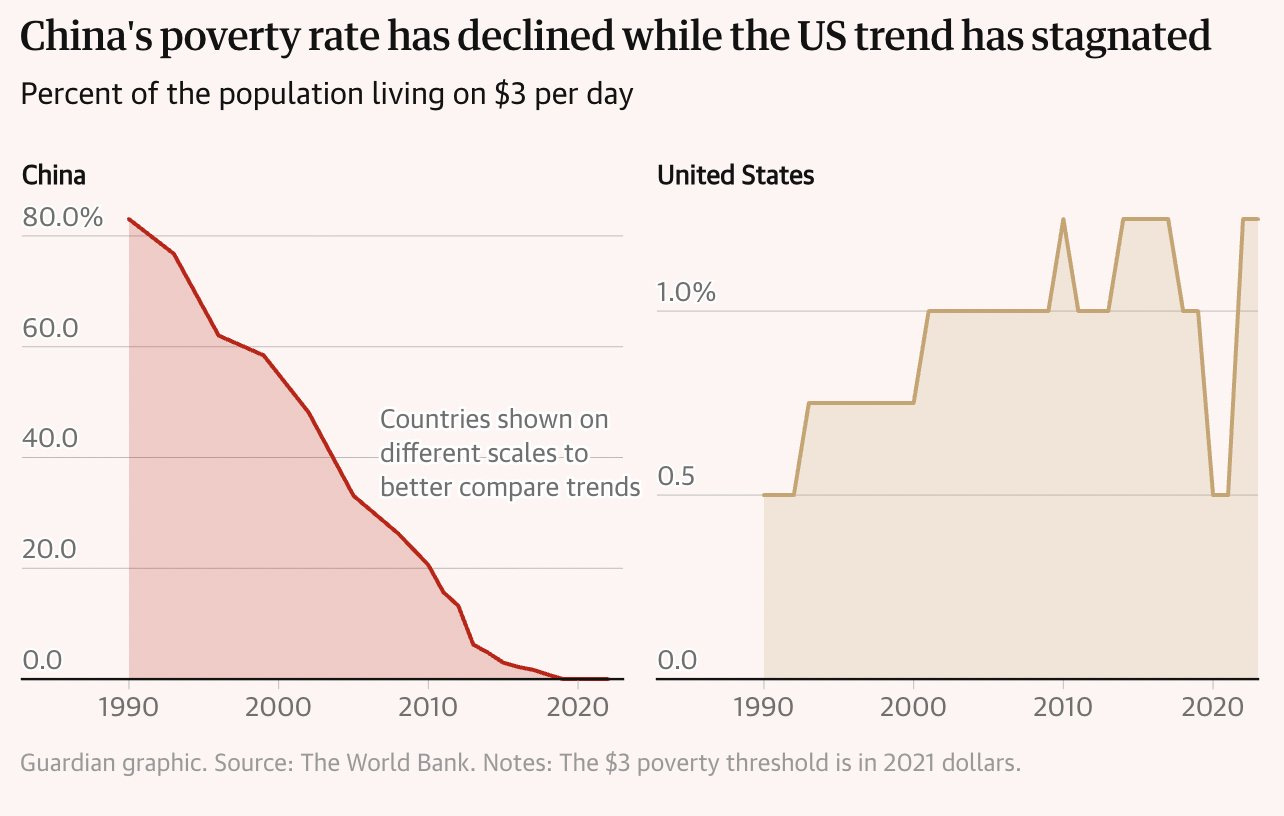
The headline makes an audacious claim: “China has brought millions out of poverty. The US has not – by choice”. The subhead is equally audacious, and sounds like it was written by ChatGPT: “Despite the US’s economic success, income inequality remains breathtaking. But this is no glitch – it’s the system”.1 This article, published by the Guardian and written by Eduardo Porter, makes some damning claims, using the chart above as a lynchpin. In 1990, over 80% of Chinese citizens lived on $3 per day or less, while 0.5% of Americans suffered the same fate. Today, the Chinese rate is near zero, while the US rate has nearly tripled to 1.25%. What’s going on?
First, this chart suffers from the same issue I’ve discussed previously in my “Terrible Chart” series: graphs with one variable but two different scales on the vertical axis. In this case, the variable in question is percent of population. Note how different the scale is. When China is the country in question, the vertical axis ranges from 0% to 80%. For the US, however, the axis begins at 0% and ends at… roughly 1.5%. This is misleading. It puts a magnifying glass on US poverty. One Twitter user equalized the scaling, and the effects are clear:
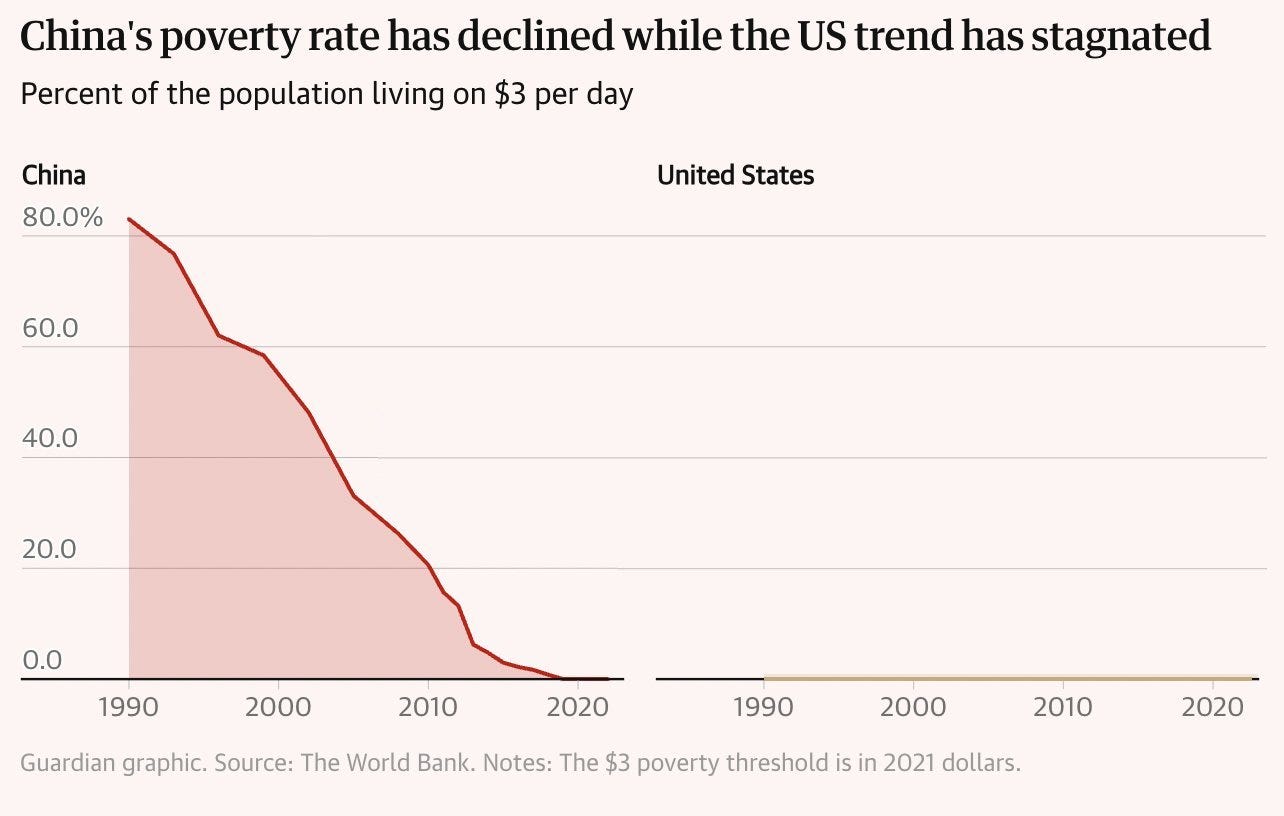
When the scales on both charts are equalized, the reader can’t even tell what’s happening in the United States! That’s because extreme poverty rates are too low.
It gets worse.
Calculating extreme poverty rates is tricky business. How do international agencies determine who is living on $3 a day, the current measure of extreme poverty, versus $5 a day? It varies. In poor and middle-income countries like China, usually by measuring consumption. Thousands of survey takers are asked how much they spend over a given period. If the total is less than $3 a day, then they are said to be living in extreme poverty. This alone has its issues. In much of the world, large portions of the lower class are subsistence farmers. They may only spend $3 a day, but their consumption is significantly higher. Some own the land and the house they live in. They grow their own food. This is still an arduous life and one the world has made enormous strides in removing, but the $3 a day is a bit of a misnomer.
High-income countries, like the United States, do not use consumption as the measurement, however. They use income. This makes a direct comparison between China and the United States impossible. One cannot compare low consumption to income and say they are the same thing. Spending is not the same as earning.
Additionally, measuring income in the United States is rife with measurement error. It may sound impossible that over 1% of Americans are earning less than $3 a day. That’s because it is. Just as subsistence farmers have consumption that goes unrecorded, so too do low-income Americans have income that is not properly accounted for. Specifically, the existence of America’s increasingly robust welfare state. Between Medicaid, housing assistance, food stamps, and a plethora of other programs, even Americans with $0 of labor income receive a great deal of money. As one study found, when welfare payments are properly accounted for, the number of Americans living on less than $3 a day is near zero. There are many Americans who earn less than $3 a day, but are given tens of thousands of dollars a year in healthcare, housing, and food benefits. Or, as one report by the World Bank found:
In practice, income is generally more volatile in the sense that it may be influenced greatly by seasonal factors or by a lack of regularity, particularly in agriculture and in the informal sector. It also has other important shortcomings, such as the frequent case of households that declare zero income on a survey, but exhibit a consumption level that is not zero.
To give an example, if someone in China has (correcting for currency differences and the cost of living) an income of $1,000 a year, $1,000 a year in government benefits, and they spend $1,500 a year, they would not qualify as being in extreme poverty because their consumption is more than $3 a day. Meanwhile, if an America has an income of $0, but receives $6,000 a year in disability payments, $4,000 a year in housing assistance, and $3,000 a year in food stamps, and they spend $18,000 a year, then that person is said to be in extreme poverty, all because their income was $0. Expenditure based on past savings and most welfare programs are ignored entirely.
Ironically, this very welfare state is one of the drivers behind the mythical increase in extreme poverty in the American data. In a society with no welfare system, people have only three options. They can be self-sufficient, depend on family, or die. As the welfare state grows, a new option opens up: they can depend on the government. This is, after all, the whole point of the welfare state: to lift citizens out of poverty or prevent them from dying because they can’t afford the necessities of life. In a world with no welfare state, people who can’t take care of themselves, absent family intervention, will perish. Dead people don’t appear in poverty statistics. In countries with robust welfare programs, the state steps in and keeps its citizens alive. Thus, the poverty rate increases. A more generous system can show up in weird statistical ways.
As I’ve written about before, the reality is that the US has made enormous strides in fighting poverty, which has halved since 1990. This amazing achievement often gets overlooked because the official poverty measure does a horrible job measuring actual poverty. It’s worth striving for continued progress, but the success we have had so far needs to be recognized at every opportunity.
Finally, one should be a little suspicious of the data coming out of China. It’s extremely difficult to get any bad statistic to zero. Illiteracy rates, maternal mortality, and other bad outcomes can drop very low, but there are always a few people who never learned to read, and women who die in labor. So just as we should be a bit skeptical when North Korea reports that its literacy is 100%, we should question whether China has truly eradicated extreme poverty. There’s no doubt it’s made enormous strides in the area, and hundreds of millions have been lifted out of poverty, but everyone? As former Chinese Premier Li Keqiang famously said with a knowing smile, Chinese data should be used “for reference only”.
I don’t know whether I’m more worried that the Guardian used AI to write a subhead, or that a human actually wrote such a meaningless sentence.