

I recently finished the biography “Truman” by noted historian David McCullough. At 977 pages of text, it is one of the longest books I have ever read. I chose “Truman” not because I was terribly interested in the 33rd president of the United States, but because the book is often listed as one of the best biographies of all time. Additionally, I was curious about post-World War II America. It often seems as if American history jumps from the end of World War II in 1945 to the election of John F. Kennedy in 1960. Never mind the beginning of the Cold War or, you know, that actual war in Korea.
The book was fantastic, although it has a few flaws. McCullough goes into too much detail in places, and I found myself skipping over a few pages now and then. Like many biographies, it also borders on hagiography, making Truman seem like a better person than he could possibly have been. That said, I greatly enjoyed reading the book. I learned a lot not only about Truman, but about the United States from 1945 to 1953, the years Truman was president.
A quick Truman timeline:
1884: Born in Missouri. He would spend his entire childhood there.
1917: Enlisted in the US Army and served bravely in Europe during WWI.
1919: Married Bess Wallace, who was part of an upper-middle-class Missouri family.
1922: Elected as a county court judge in Missouri as part of the local Democratic political machine. This was not a judicial role, and would be akin to a county administrator today.
1934: Elected to the US Senate from Missouri.
1940: Chaired what became known as the “Truman Committee”, which sought to remove waste and profiteering during World War II. This raised his profile to the national level for the first time.
1944: Elected as Franklin Delano Roosevelt’s vice president.
1945: FDR dies three months into his fourth term. Truman becomes president.
1948: Truman is reelected president in his own right.
1953: Truman’s second term ends, and he retires.
1972: Truman dies of pneumonia at age 88.
Below are some additional facts I found interesting.
Contrary to what many today believe, education in rural America in the early 20th century was not for men. According to McCullough, “High school, like piano lessons, was primarily for girls. In Harry’s class, largest yet at the new high school, there were thirty girls and just eleven boys.”
When serving in World War I, Truman ran the regimental canteen. This taught him excellent management skills, similar to the skills Ulysses S. Grant learned when he served as quartermaster during the Mexican-American War. He also saw extensive action. While serving in WWI, Harry Truman was promoted to Captain, but was never told. He only found out after seeing it in the New York Times.
The Truman Committee, especially today, stands out for its bipartisanship. Their goal was to identify government money being wasted or stolen among the billions of dollars of government contracts going to fund WWII. Instead of playing favorites, members of both parties diligently worked to make sure Uncle Sam’s money was being spent responsibly. They excelled at this, saving the government millions and helping the country stay on a war footing.
As FDR prepared to run for a fourth term, it was clear he might die in office and needed a new vice president who would be up to the job as president. He liked the idea of Truman, but was concerned about the latter’s age. Roosevelt told an aide that he thought Truman might be nearing 60 and was too old. The aide knew that, in fact, Truman already was 60, but supported Harry’s candidacy as Vice President. Eventually, Roosevelt sent for a book that listed every senator’s age, which the aide dutifully retrieved, but kept it out of sight, and Roosevelt forgot to ever look it up. That forgotten request may have changed history.
As it was, Roosevelt was easily reelected in 1944 and began his fourth term in January of 1945, but died after just three months. It was around 5PM on April 12, 1945, when Truman received a call from the White House at the Capitol Building. Steve Early, the White House Press Secretary, told Truman to come to the White House as “quickly and quietly” as he could. Truman turned white and said, “Jesus Christ and General Jackson.”
What happened next seems like something straight out of a movie. When he arrived at the White House, he was met by Eleanor Roosevelt.
“Harry, the president is dead,” she said.
“Is there anything I can do for you?” Truman asked.
“Is there anything we can do for you?” she replied, “for you are the one in trouble now.”
Both Harry Truman and his wife, Bess, were quite fond of bourbon. Shortly after arriving in the White House, Bess ordered an old-fashioned with dinner. The bartender made it the usual way at the time: an ounce of bourbon, orange slices, a teaspoon of sugar, and bitters. This was far too sweet for Bess’s liking, and she asked that future old-fashioned drinks be less sweet. The next night, however, was not much better, and Bess told the White House usher it was the worst old-fashioned she had ever tasted, and she didn’t “care for fruit punch”. The third night, the bartender simply poured two ounces of bourbon on ice and served that. Bess took a sip, looked at the bartender, and said, “Now that’s the way we like our old-fashioneds.”
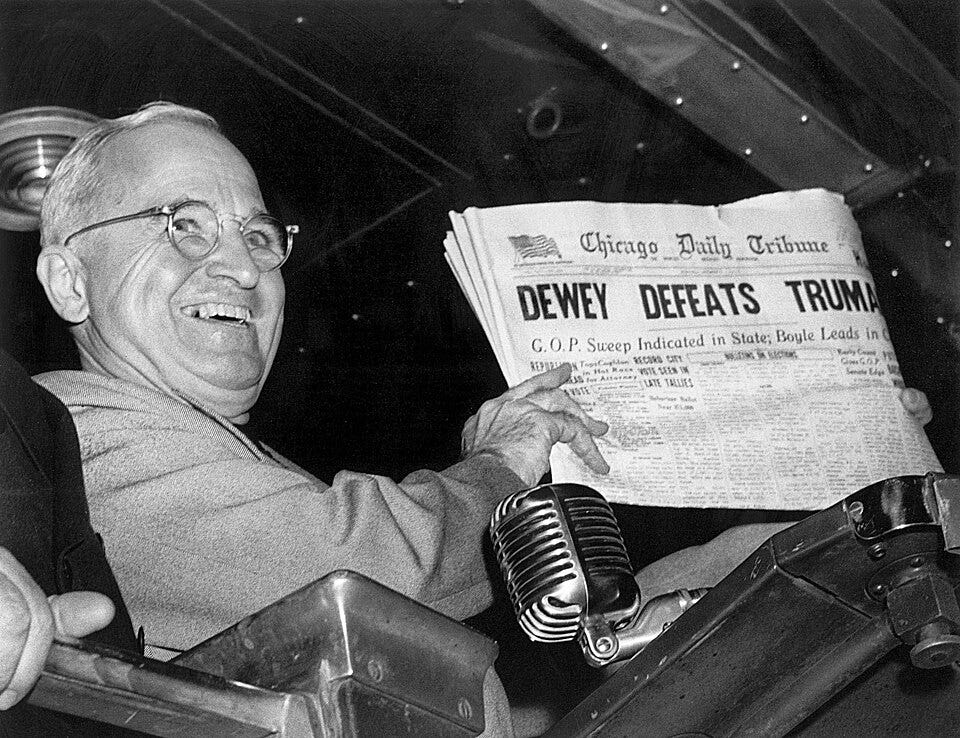
After several missteps and still in the shadow of Roosevelt, Truman entered the 1948 campaign as an underdog. Public polling, a recent invention by Gallup, consistently showed his approval rating below 40 percent. His opponent, Thomas Dewey, was an experienced politician who had learned much after losing to FDR in 1944. Everyone thought Truman would lose. He responded by inventing the modern-day presidential campaign. He traveled the country by train, speaking in hundreds of towns across America. Few thought it would work, leading the Chicago Tribune to famously print the headline, “Dewey Defeats Truman” in advance of the election results. To the surprise of many, Truman pulled the upset and won reelection relatively easily. His whistle-stop train tour should be given credit for changing the tide. As one comedian quipped, “Harry Truman was the first president to lose in a Gallup and win in a walk.”
On June 25th, 1950, thousands of North Korean troops crossed the 38th parallel and invaded South Korea. There was nothing unique about the demarcation line of the two Koreas that exists to this day. Before WWII, the entire Korean peninsula had been occupied by Japan. At the end of the war, the US and USSR divided Korea much the same way Germany had been divided by the allies. Those North of the line would surrender to the Soviets. Those South, to the Americans. The 38th parallel was chosen simply because it roughly divided Korea in half and because it was already on most maps of Korea. History can be odd sometimes.
The Korean War would become a millstone around Truman’s neck. Despite some military successes, the war dragged on longer and was far more costly than most had initially anticipated. Over 36,000 American soldiers would die in Korea, and eventually the war would stalemate at the 38th parallel, nearly exactly where things had started years before.
Truman’s biggest mistake as president was to write an unhinged letter to a journalist who wrote a negative review of a singing performance by Margaret Truman, Harry’s daughter. Harry wrote that the journalist was a “frustrated old man” and said if they ever met, the journalist would need “a new nose, a lot of beefsteak for black eyes, and perhaps a supporter below!”
The letter from Truman was printed in the journalist’s newspaper the next day. This was a terrible look for the normally reserved president, especially with war raging in Korea. Thousands of people wrote to him expressing their disapproval. One letter in particular stuck with him:
Mr. Truman:
As you have been directly responsible for the loss of our son’s life in Korea, you might just as well keep this emblem on display in your trophy room, as a memory of one of your historic deeds.
One major regret at this time is that your daughter was not there to receive the same treatment as our son received in Korea.
Enclosed with the letter was a Purple Heart awarded to the son before he was killed in action. Truman kept the letter in his desk for years, no doubt using it to remind him of the stakes of his decisions.
One story stuck out as a reminder of just how racist America was at the time. In 1950, Sergeant John Rice of Sioux City, Iowa, was killed in Korea. Months later, his body was returned home, and he was to be interred at Sioux City Memorial Park. As the casket was literally about to be lowered into the grave, however, city officials stopped the ceremony and said Sergeant Rice couldn’t be buried there because it was a whites-only cemetery. John Rice was native American. Truman, reading about this, immediately sent an Air Force plane to pick up the body and Rice’s widow and three children. Sergeant John Rice was then buried in Arlington National Cemetery with full military honors.
The closest Truman came to being assassinated was on November 1, 1950. Two Puerto Rican secessionists attempted to kill Truman while he was residing at the Blair House in Washington during major White House renovations. The two men opened fire at White House police officers and Secret Service agents. Officer Leslie Coffelt was shot three times in the chest and abdomen at close range in his guard booth. As the shooters engaged with other officers, Coffelt somehow kept his composure. In an event straight out of an action movie, he propped himself up against his guard booth, and fired his service revolver once, hitting one of the attackers in head and killing him from a distance of 30 feet. Coffelt then collapsed and died at the hospital four hours later. What an incredible last act of heroism. The other attacker was wounded and captured. Truman did stick his head out of his bedroom window at one point to see what was happening, but was unharmed.
Winston Churchill met with Truman during the Potsdam Conference in 1945. The meetings did not go great, and the two would not see each other again until Churchill visited the United States in 1952. In an amazing admission, Churchill told Truman, “I must confess, sir, I held you in very low regard then. I loathed your taking the place of Franklin Roosevelt. I misjudged you badly. Since that time, you more than any other man have saved Western civilization.”
Truman had a long ex-presidency, nearly 20 years, that was mostly uneventful. Like many ex-presidents, at times he resented the loss of the limelight and lack of advice sought from him. Overall, however, the last decades of his life were happy ones. He spent them as a private citizen back in Independence, Missouri. He opened the second presidential library and enjoyed old age, saying, “When a good politician dies he becomes a statesmen. I want to continue as a politician for a long time.”