

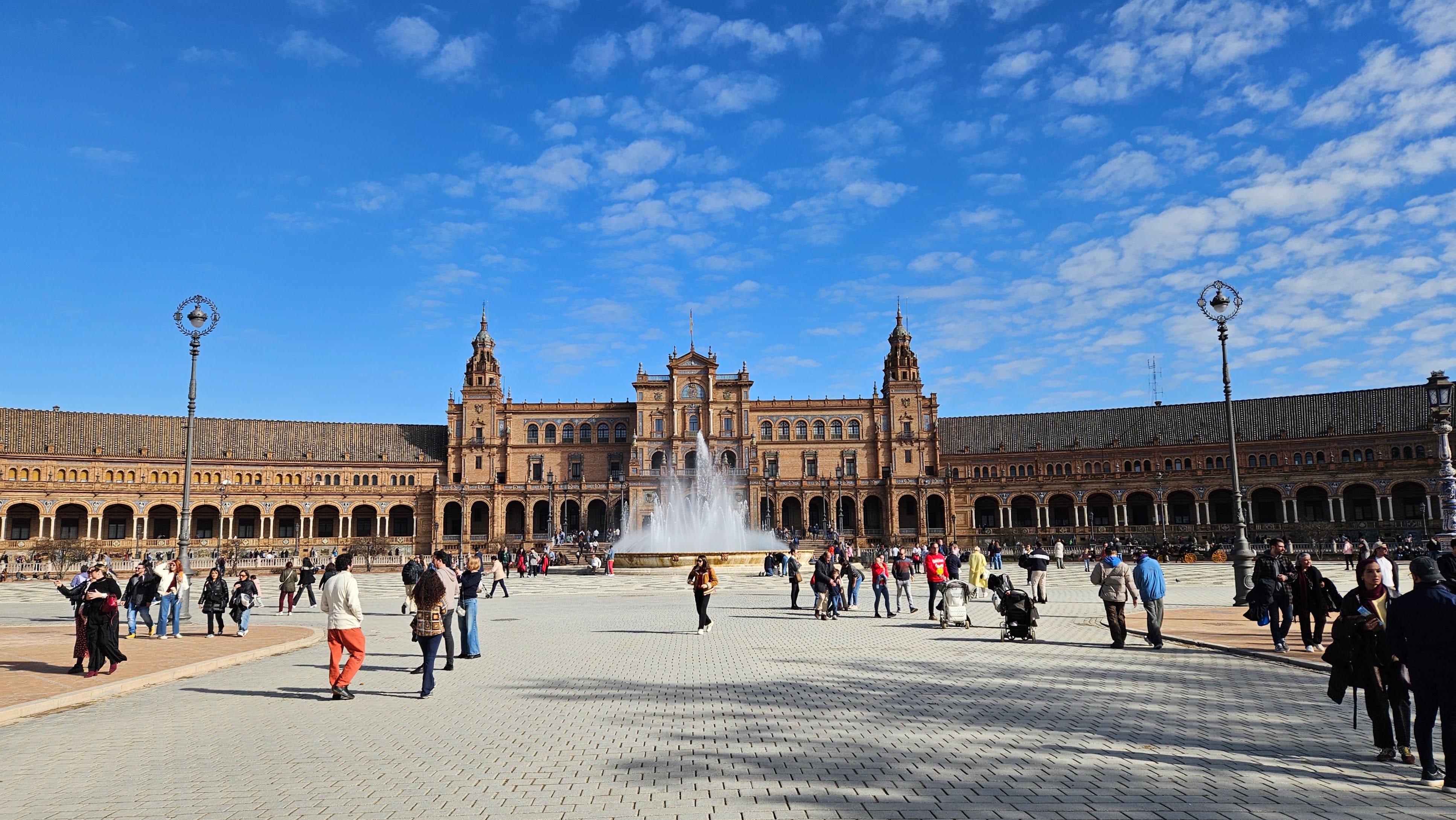
After Christmas but before New Year’s, I decamped from the United States to Spain for two weeks with my wife and two young children. We visited Granada, Sevilla, and Madrid, with day trips to Cordoba and Toledo. I’d been to Barcelona several times, but had not seen any other part of Spain. My wife and kids had never been at all. We decided to go because New England is rather chilly and gloomy in January, and we could use a bit of sun. I’d also wanted to visit Andalusia (southern Spain) for some time. Here are some of my notes on La Piel de Toro.
Seville or Sevilla? This is one of the few cities that is in transition between its Anglicized and native name. In most cases, hearing the native pronunciation by an English speaker (“I just loved our trip to Roma and Milano last May!”) is a sure sign the person you’re talking to is a tool. Sevilla, however, has become standard in at least millennial American English. Because everyone I know who’s visited or studied abroad there for the last 15 years has called it Sevilla, I’ve fallen into the habit myself. Until recently, I didn’t even realize “The Barber of Seville” and friends who had just visited “Sevilla” were referring to the same place. At the risk of sounding like the pretentious traveler I abhor, I’ll stick with the native spelling and pronunciation.
Granada, Sevilla, and Madrid are all fantastic places. I could spend a week in any one of them and not be bored. If you’re looking for a new part of Europe to visit, you can’t go wrong here.
Granada, which, at half the size of Sevilla, is easily the smallest of the three, is a delightfully unique small city. The urban core is classic Spain - filled with balconies and restaurant-abundant plazas. The Albaicín, the largest and best-preserved Moorish neighborhood in Europe, is a clash of cultures reminiscent of Sarajevo or Istanbul. The Alhambra is one of Europe’s top sites. Granada is also the last redoubt of the Spanish tradition of serving free tapas along with a drink. It’s amazing. You order a beer, and it comes with a free snack! Order another drink, another snack! And the drinks are reasonably priced. What a city.
I found the Alhambra, the Moorish-cum-Christian fortress and palace complex that overlooks the city, to be underwhelming. I’ve heard people say it’s their favorite building in Europe. ChatGPT put it #1 in its architectural power rankings. And it… just didn’t do it for me. Don’t get me wrong, it’s still a highly worthwhile tourist attraction. The plaster designs on the walls are astoundingly intricate and beautiful. The views from the parapets are lovely. The interplay of water and mortar is exceptional. It’s a cool place, and a must-see while in Granada. But the best building in Europe? It wasn’t even my favorite building in Granada (that goes to the Granada Cathedral). Architecturally, I preferred the Alcazar of Sevilla. The plaster designs on the walls are gorgeous, but that’s all they are: plaster designs put on stucco walls. The views are nice, but every hilly city in Europe has an old building with great views. The Alhambra is also completely empty. I could only read, “Imagine this room filled with lavish carpets, incense, and sumptuous drapery,” so many times. Even if the furniture is all replicas, I prefer classic buildings that aren’t just empty rooms.

Sevilla is one of the most beautiful cities in Europe. Block after block after block of wonderful buildings from several different eras. A veritable Instagram factory. The Santa Cruz neighborhood looks like something out of Disney World. And in fact it kind of is - the neighborhood was given a massive overhaul before the Ibero-American Exposition of 1929, making it both a somewhat contrived neighborhood, but one that, now almost a century old, has become authentic. The Sevilla Cathedral, although packed, is the pinnacle of Gothic architecture. Las Setas is one of the top monuments of the 21st century. Set pieces like the cathedral aside, Sevilla is just a wonderful city, one I could go back to again and again.
Photo of Las Setas in Sevilla by Sergio Guardiola Herrador on Unsplash Madrid is a true city. A real, urban area that you don’t often find in Europe. It’s crowded, yes, but at least in January, not crowded with tourists. It’s a city that’s filled with locals, walking with their families or to work or who knows where. There is an energy in Madrid that I hadn’t felt anywhere else in Southern Europe. People seem to have a drive about them one more associates with the Swiss than the Spanish. I loved the feel of Madrid.
Given its size and importance, I don’t understand why its popularity has lagged so far behind Paris, London, and Rome. To be sure, I’m not claiming Madrid is an “off the beaten path” destination. It isn’t, however, viewed as a top-tier European capital. I don’t know why. The city is beautiful, filled with wide boulevards and Beaux-Arts architecture. The Prado is generally viewed as the second-greatest art museum in the world. The Royal Palace is one of the best in Europe. Yet for whatever reason, Emily in Paris is unlikely to spend half a season in Madrid as she did in Rome.
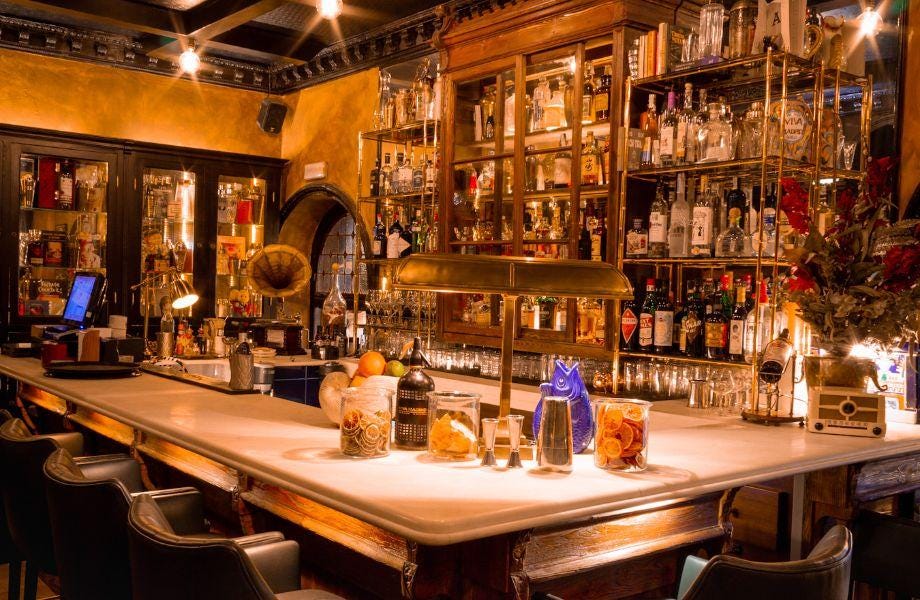
The bar scene in Madrid is top tier. The city is filled with gorgeous bars of various types. From Belgian beer bars to traditional Spanish taverns with fancy cocktails, there are beautiful bars throughout the city. Many, in contrast to much of the world, have large windows facing the street. It was great to walk around the city and watch Madrileños enjoying their weekend through the windows. Also, the bartenders in Spain were unbelievably friendly. I had multiple conversations, in English, with several. Even in crowded spots they seemed interested in who I was and what I was doing in Spain. My only complaint is that even the fancy bars premix their cocktails, leaving one to wonder how much whiskey is really in the drink I just ordered. Overall, though, if you want to have a classy night out on the town, it’s hard to think of a better place to do it than Madrid.

Our day trips to Cordoba (from Sevilla) and Toledo (from Madrid) were very worthwhile. Toledo is a bit rough to navigate with two strollers, but the old town is beautiful, and the cathedral is world-class. In Cordoba, though, there is a real gem of a building: the Mosque-Cathedral, also known as the Mezquita. Built as a mosque over a thousand years ago, it was converted to a Cathedral in 1236. Over the centuries, it has been expanded, renovated, and refurbished countless times. The result is a mishmash of cultures unlike anything I have ever seen. In contrast to the Alhambra in Granada or the Hagia Sophia in Istanbul, the Mezquita wasn’t just added to or rebranded; it is a true combination of Moorish and Christian architecture. It’s trite-but-true: pictures don’t do it justice. Suffice it to say that if you’re ever in Andalusia, a visit to the Mosque-Cathedral of Cordoba is an absolute must.

Other than the hustle and bustle of Madrid, we found the stereotype that southern Europeans never work to be hilariously on point. Arriving in Granada on December 30th, I was excited to see the end of the holiday season and then the regular swing of Spanish winter. But the holidays don’t end in Spain. Nor are they what a typical American would expect. New Year’s Eve is more of a family event in Southern Spain, to the point that restaurants, rather than keeping their usual late hours, often close around 8 PM. As is to be expected, much is closed on January 1st. But then, at least in Granada, January 2nd celebrates the victory of Christian forces over the Moors. Another holiday. Then, the Epiphany is also celebrated, with most shut down on January 5th and 6th. But wait! Because many Spaniards do gifts on January 6th, rather than December 25th, January 7th has become a kind of retail holiday, when everyone goes to stores to make returns and spend their newly held cash. I’m still not really sure when the holiday season officially ends in Spain. Madrid was still working on taking down the massive Christmas tree in Puerta del Sol when I walked by on January 12th.
Speaking of dinners, people do eat late here. Lunch spots often open at 1:30 PM. They close around 4 PM, and then might not reopen until 8 PM. The odd thing is, it isn’t really that much later in the day, at least in the true astronomical sense of the meaning. As I’ve written about previously, Spain is in the wrong time zone. Solar noon isn’t until after 1 PM in the winter, and lags until after 2 PM in the summer. School and work doesn’t start until 9 AM, sometimes later. I asked a waiter when the most desirable dinner reservation time was in Spain. He said 8:30 PM. That’s basically the equivalent of 7 PM on the East Coast from a true “where is the sun time of day perspective”. It would be as if New England back two time zones, but also moved back most aspects of life by two hours as well, canceling out any true change in the time of day. It’s strange to get used to the new numbers on the clock that correspond with various activities, but things aren’t as late as you think.
Football may be the national sport of Spain, but Spain’s national pastime is undoubtedly walking. The streets, especially in the evenings, are filled with families and friends strolling. The Spanish call it El Paseo. Even in January, people fill the streets late into the night and walk around.
You would think this would make the Spanish great at walking through crowded areas. To the contrary, they suck at it. In any city in the world there are inconsiderate people who will spontaneously stop in the middle of a crowded sidewalk or slowly veer into oncoming pedestrians. In Spain, however, this is constant. Walking along a crowded Spanish street is like being on the bunny hill at a popular ski resort. There’s no way to predict at what speed the person next to you is about to go or in what direction they plan on heading. It made traveling with two kids in strollers a bit interesting. On the other hand, I’m envious of a society that has maintained the evening stroll as a crucial part of its culture. What a great way to stay in touch with neighbors and the community. I wish I could happily stroll for hours on Sunday evenings, seemingly not caring about the Monday ahead or how many people I cut off along the way.
The Spanish love children. My two kids were constantly smiled at, adored, given high-fives, and to my delight, allowed to cut the line at the airport. One waitress gravely told us, “It is dangerous for you to bring your two children to Spain. All the old ladies will come up and pinch their cheeks!” Spanish children are also much more part of the fabric of society. Walking around after 11 PM one night in Sevilla, I saw multiple strollers. Nice restaurants would have young children eating next to their parents well into the night.
I was also touched by how much people were willing to help us move around. In any country, strangers will offer assistance to a parent trying to get a stroller up or down steps. In Spain, however, it was constant. I once saw an oncoming pedestrian see my wife and I approaching a set of steps with our two strollers from a distance, and he slowed his pace down so that we would arrive at the top of the steps at the same time and he could ask, in English, if we needed assistance, as if it was the most trifling of concerns to lug 50 pounds of stroller and baby down 15 uneven stairs that he had just climbed.
This was my first trip using a Rick Steves guidebook, in this case, his Best of Spain. I don’t know much about Rick Steves, other than he has a significant following that treats his pronouncements as gospel and a much smaller group of detractors that strongly dislike him for reasons that are unclear. My overall assessment is that his guidebook was excellent, although his list of important attractions sometimes differs from what the TripAdvisor hivemind suggests. I enjoyed his commentary and insights into Spanish life. The book, however, was worth its weight in gold when touring famous sites. Several cathedrals, art museums, and even neighborhoods had detailed guides explaining various chapels, paintings, and streets. The walking tours were especially useful and made our strolls around the city much more enjoyable. I’ve found museum audio guides to generally be of poor quality, but Rick Steves’ explanations were on point. I also liked being able to open a guidebook to look at a map and not always have to pull out my phone.
The food of Spain is surprisingly mid. Spanish food isn’t bad, but it’s significantly worse than French or Italian. I’d also put it a step below Portuguese cuisine. Oddly, we found that the quality of the food was not proportional to the price. Most of the best meals we had were tapas-based. The few times we went to more expensive meals, it underwhelmed. Meat was dry and overcooked, there was a lack of fresh veggies, etc. We had an excellent meal on our final night in Madrid at a Michelin Bib Gourmand spot, but especially given Spain’s history, the food was weak.
Spain is at its best with art and architecture. The Cathedrals and churches are on par with Italy as the best in the world. Both the exteriors and interiors are well-preserved and inspiring. The side chapels of Spain’s cathedrals are themselves magnificent. I was constantly in awe at the ornateness and grandiosity of Spain’s churches.
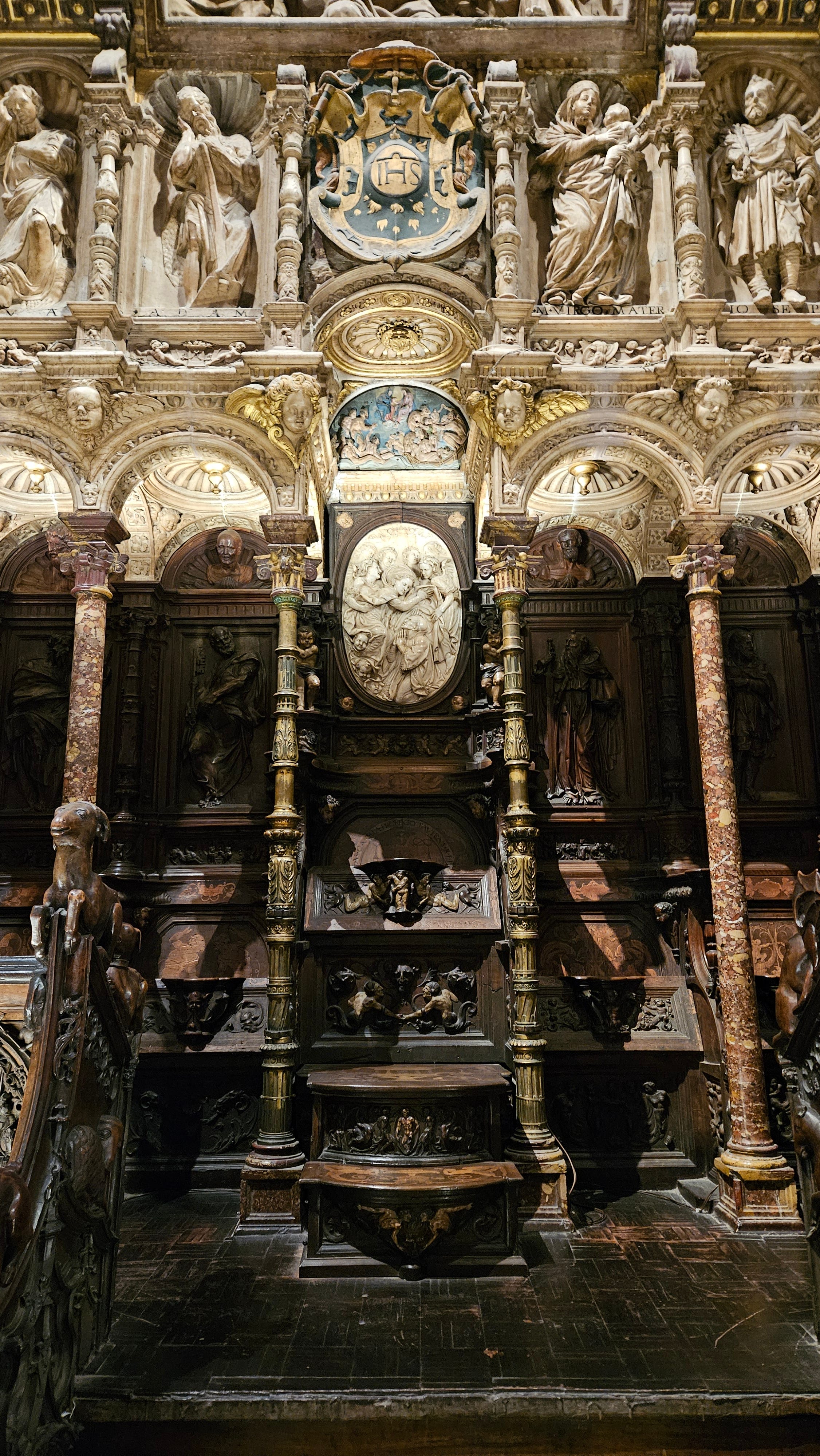
In Spain, the Catholic church is alive and well. Especially over the holidays, many people would be coming and going to mass. Across the street from my Airbnb in Sevilla, there was a small church. Like many Spanish churches, there was a painting of Mary flanked by two lamps on the outside. One weekday morning, I saw a man around the age of 30 dressed in business casual clothes come around the corner, make purposeful eye contact with the portrait, cross himself while mumbling a religious intonation, all while not breaking stride. It was a meaningful act of devotion that plays out every day across Spain.
The major downside to Spanish cathedrals is they are expensive to visit. As many predicted, those initial low tourist fees of €5 of a decade ago that were ostensibly charged to help pay for the direct costs of managing thousands of tourists have slowly evolved into standard museum prices. To visit the Granada Cathedral and Royal Chapel is €12. The Cordoba Mosque-Cathedral is €13. The Sevilla Cathedral, €14. Ironically, many of Spain’s top secular attractions offer discounted or free tickets. We went to the Prado, Reina Sofia, and Sevilla Alcazar either for free or steeply discounted. The one thing I had to pay full freight for was every church. This, despite the fact I’m a practicing Catholic. It doesn’t sit well with me.
The art, too, is simply stupendous. I knew the Prado in Madrid was one of the top museums in Europe, but I wasn’t ready for the sheer number of A-list painters and paintings. Velázquez’s “Las Meninas” and Bosch’s “The Garden of Earthly Delights” are the top two, but there are countless other masterpieces. I also enjoyed that while the museum was not at all empty, it didn’t have the crushing crowds of the Louvre or the Vatican. Near the Prado, Picasso’s “Guernica” can be seen at the Reina Sofia. Throughout the rest of Spain, one can find lesser-known but still fantastic works of art, such as El Greco’s “The Burial of the Count of Orgaz” in a small church in Toledo. I hadn’t realized just how much wonderful art was scattered throughout Spain.
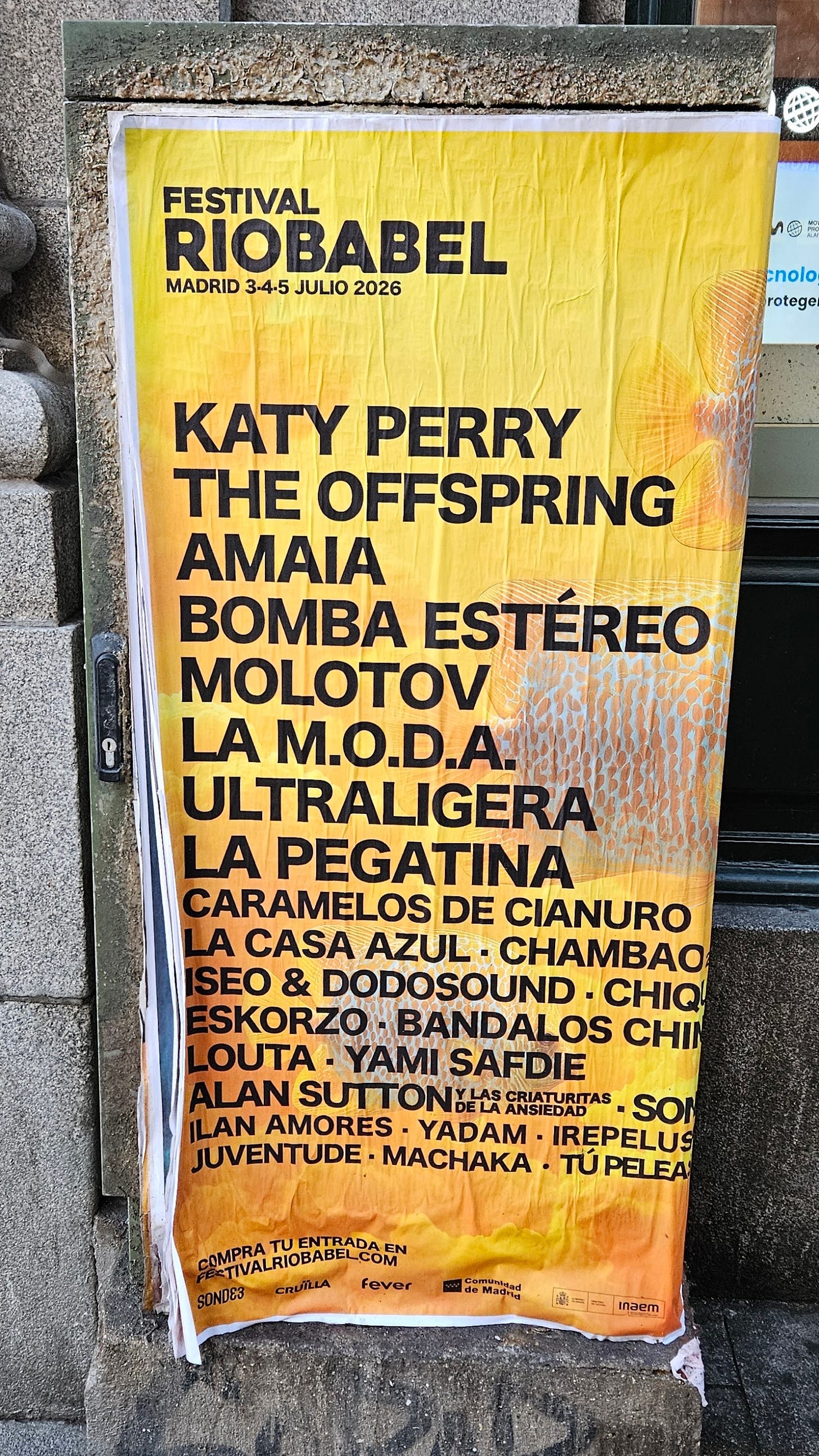
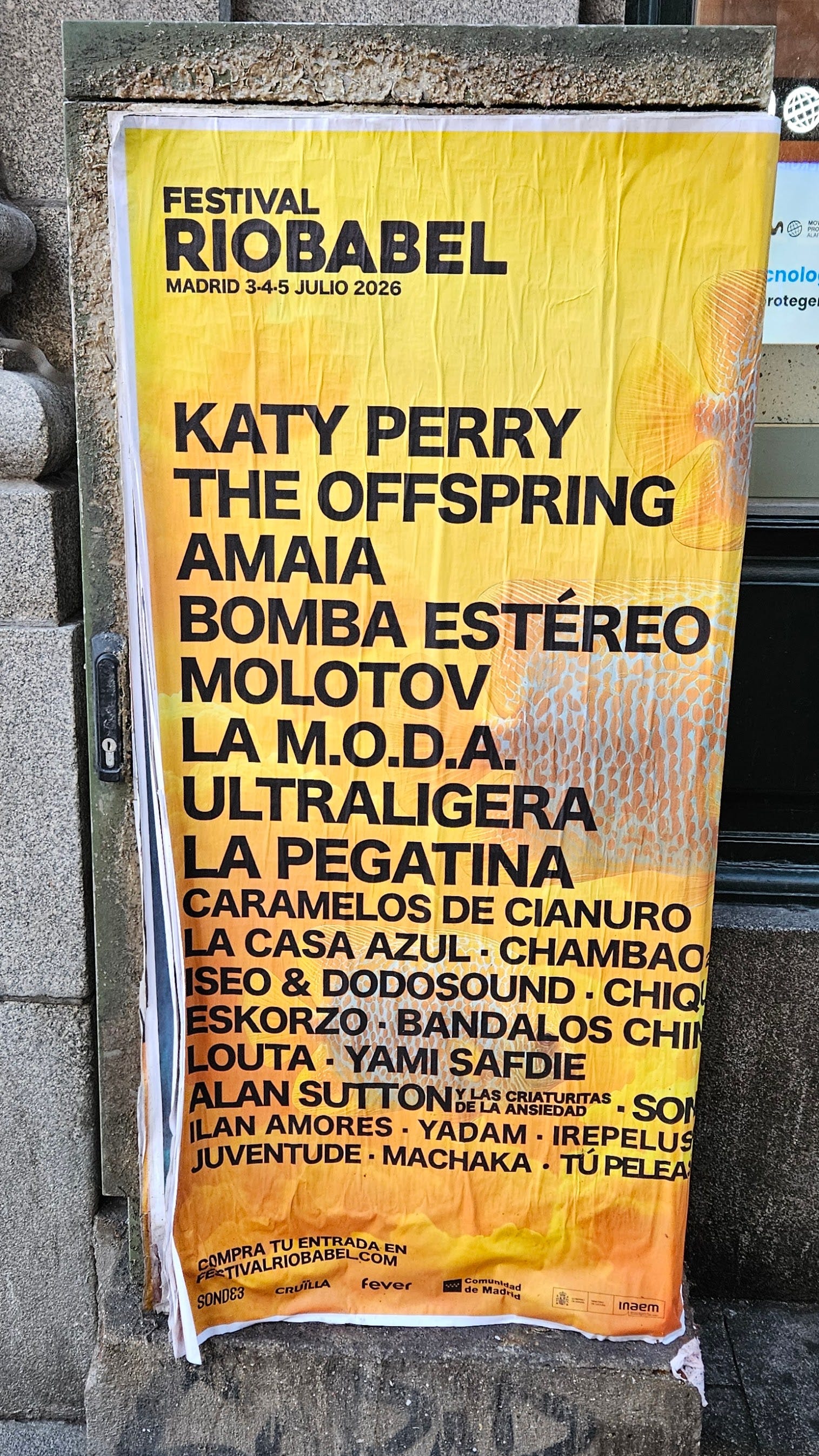
Finally, a digression. In 2011, I found myself in a small village in Southeastern Laos while on a solo motorbike tour of the landlocked Asian nation. Evening was approaching, and I needed to figure out where I was going to spend the night. I walked into a local restaurant/bar, which was more of a shack than anything else. Thatch roof, walls made of reeds, plastic chairs, and a simple dirt floor. To my surprise, the bar had a fairly sophisticated speaker system. To my astonishment, Katy Perry was playing. This led to my first rule of travel: no matter where you are in the world, you cannot escape American culture. Corollary Rule 1.a: the American culture will usually be Katy Perry. To wit, this poster in Madrid:
Well, know we know where "Jesus H. Christ" comes from :p
Great photo too!
Spain's architecture is excellent (even seen from afar). You'll have to go to Barcelona on your next trip and see Antoni Gaudí's architecture. I've seen it called "Spanish Art Nouveau", and it's hard to believe that there existed a 20th century architect who could make something not either a shoebox on its end or a neoclassical imitation, much less one of Gaudí's erections.
Viva España!