


A recent New York Times (NYT) article by Priya Krishna discusses the current state of the food delivery industry. The headline statistic is that three in four restaurant orders are now either carry-out or delivery. Many restaurants have now become caterers with a physical premise. Below are some excerpts from the article, along with my comments.
There’s pasta in the pantry and jarred sauce in the refrigerator. So what compels Kiely Reedy to keep having spaghetti with marinara delivered from the restaurant down the street, for several times the cost of cooking the dish herself?
It’s not that the restaurant dish is particularly good, she said. “It’s the instant gratification.”
From her roughly $50,000 annual salary as a data processor in San Diego, Ms. Reedy, 34, spends at least $200 to $300 a week on food delivery. Ordering in has eaten away at her savings, she said, and led her to socialize less. She tips generously, but worries that the delivery drivers are poorly paid.
Bruh. $250 a week on food delivery is $13,000 a year. After accounting for taxes and welfare programs, that’s roughly 30% of her take-home pay. On food!
In 2024, almost three of every four restaurant orders were not eaten in a restaurant, according to data from the National Restaurant Association. The number of households using delivery had roughly doubled from 2019, just before the pandemic, the group said. And in a survey last year, about one-third of American adults told the association that they ordered food for delivery at least once a week.
Those are surprising numbers. One caveat - how are orders being calculated? People are more likely to order takeout solo and eat in restaurants in groups. So if four people each ordering out count as four orders, but the same four people sitting at the same table count as one order, that would skew the stats. Regardless, it’s indisputable that takeaway orders have become much more popular.
I find the second stat more surprising. One-third of Americans get food delivered at least once a week? That’s a tremendous shift in how prepared meals are transported and consumed.
We asked New York Times readers to share their feelings about food delivery. Most of the nearly 900 who responded said they prized the extra time and freedom it gives them, but expressed misgivings about the costs for delivery drivers, the environment and their own wallets at a time when affordable living feels increasingly out of reach.
New York Times readers are an interesting bunch. They patronize a company, but then have misgivings about it. What a great example of performative guilt. Obviously, if customers had true misgivings, they would not purchase a superfluous good. It would be like avid golfers complaining about the amount of water a golf course uses. If you don’t like it, stop golfing.
The environmental concerns, which are mentioned several times in the article, are also performative. Eating foods like beef or almonds is more damaging to the environment than a to-go container. While all that plastic isn’t good, it also isn’t meaningfully contributing to global warming or most other environmental problems. Like paper straws, it’s a small issue that ignores the much bigger one: fossil fuels.
That message has a special resonance for the working parents we heard from. Between raising two young boys and putting in long hours at a marketing job in Atlanta, Kevin Caldwell can almost never find the time to make dinner. So he and his husband spend about $700 a week to order in…
…His 4-year-old son doesn’t read yet, “but he can put together an order” on the Chick-fil-A app, said Mr. Caldwell, 39. “I am impressed, but I am also terrified.”
Again, holy cow! That’s $36,400 on delivery. Must be nice to have that much disposable income. There’s no way to say this without sounding snotty, but maybe raising two young boys includes teaching them how to cook, rather than teaching them how to use Uber Eats.
Missy Auge, who recently moved home to Santa Fe from Los Angeles to work as a sommelier, has most of her food delivered. She no longer feels the social pressure she once did to meet friends for dinner.
Food delivery is yet another force pushing our society towards atomization. Even the sommeliers are eating at home by themselves.
Still, such an on-demand lifestyle can keep consumers from developing critical skills like problem solving, planning ahead or making tough decisions, said Huy Do, a research and insights manager at the market research firm Datassential. That’s why so many young people are “choosing to make financial and food-based decisions in the moment that feel good now,” said Mr. Do, even though it can prevent them from making longer-term financial investments.
This is a good point and an underdiscussed downside to new technology: it increases dependence. Now, often the gains outweigh the losses. I’m totally dependent on my washing machine to do my clothes, the electric company to keep the lights on, the plumber to fix my boiler, etc. 100 years ago I would have had a much better understanding of the inner workings that keep my world in orbit. The difference between other conveniences and food delivery is the former save money in the long run, especially when including time costs. A washing machine is expensive, but it automates unskilled labor that would take a person hundreds of hours a year. Food delivery both fosters dependence and costs a pretty penny.
Food delivery services offer convenience, but at a high cost. If used constantly, it also destroys a skill: preparing your own food. Being able find a recipe, buy things from a store, and cook a meal might not sound like much, but being able to regularly do so likely correlates strongly with a lot of other positive attributes. Food preparation requires discipline day in and day out. Unhealthy or expensive alternatives are always readily available. It requires flexibility. When the supermarket doesn’t have an item, one has to audible to a reasonable substitute. And of course cooking itself is a useful skill. It can take years of practice, but being able to look at a pantry and create a meal on the fly is incredibly useful. Having a general sense of how long to cook each ingredient and in what order to cook them, without a recipe, will always be a worthwhile skill.
Austin Layne, 31, who drives for Uber Eats in Los Angeles, said he needs that extra income to supplement his salary as a data analyst…Another reason Mr. Layne stays at it is to pay off his debt from ordering too much food delivery. He has since cut back on the habit.
A good dealer doesn’t use his own product.
Will Parks, 36, decided to pare back after looking at his annual credit card report in 2024 and realizing that he had spent about a third of his money on ordering in.
“Food delivery is a scam,” he said. “It is incredibly expensive, the quality has gone down precipitously and with costs being so high, I took a hard look at it and was like, ‘This is a waste of my cash and time.’”
“You feel kind of tricked,” added Mr. Parks, who works in strategy for an entertainment company in Los Angeles. “You have reshaped your life based on their business model.”
I disagree that the delivery apps are “tricking” anyone. One can gripe that the fees are added at the end, making something they are getting a meal for $40 when it actually will cost $50, but this is the same as hotel rooms, concert tickets, or even eating at a restaurant. I also don’t think the quality has “gone down precipitously”. It’s still the same delivery service and the same restaurants. Unless the delivery time has increased dramatically or something like that, prices have gone up, but quality has stayed the same.
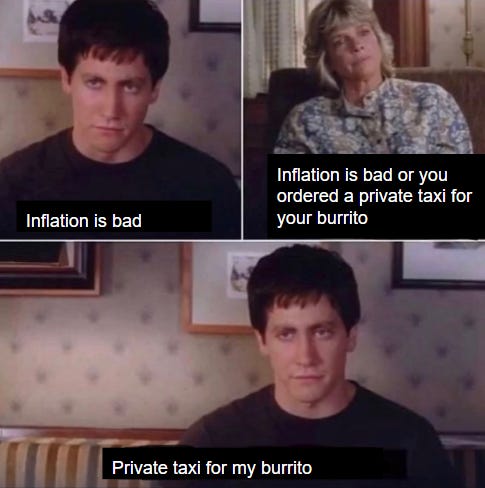
The prices, however, are astonishing. It’s hard to believe how much people are willing to pay for delivery. How do more not have a basic common sense alarm that goes off when they are paying a massive premium for a burrito taxi:
How much are people paying? Here’s one example. In New Haven, Connecticut, there is a popular chain called Haven Hot Chicken. It’s a counter joint with pretty good hot chicken sandwiches. To have a single hot chicken sandwich delivered to my door, no fries, drink, or anything like that, costs an exorbitant $20.81. And that’s with $1.98 saved via “promotions”, whatever that means. For a hot chicken sandwich! Buying the sandwich at the restaurant would only cost $14.43, which is already quite expensive. $20.81 is a 44% markup. Not including tip. For a chicken sandwich. I don’t want to go full-blown Caleb Hammer, but what are you people thinking? Even going to the restaurant yourself would save quite a bit of money over time.
In weaning himself from delivery, he has discovered a new passion — something that allows him to step away from his phone, focus on a task and feel a sense of accomplishment: cooking.
Preparing a meal takes far more time than ordering dinner with the press of a button. But “it feels good,” he said. “It feels more adult, frankly.”
This is a point that needs to be repeated. Cooking is a great skill. It’s practical. It saves money. It’s useful in building social capital. Plus, cooking after a long day at the office, far from being an additional stressor, can be a great way to wind down, especially if done with a familiar recipe and beer in hand.
Overall, I thought the New York Times article did a good job explaining an important evolution in the industry. However, there were two omissions I would have included.
First, food delivery vs. cooking at home is a false dichotomy. There are other options. Trader Joe’s has dozens of cheap, edible, frozen meals that need a few minutes in the microwave and are ready to go. Costco as well. Now, these aren’t particularly healthy. The sodium content can be off the charts, but then again, restaurant food isn’t exactly the gold standard of nutrition.
Plus, cooking doesn’t have to mean slaving away for hours and making pasta from scratch. There are many meals people can make at home that barely qualify as cooking, if they qualify at all. A rotisserie chicken can be shredded and added to a salad, combined with cheese and mayo to throw in a chicken salad sandwich, dipped directly into BBQ sauce, etc. Cooking noodles and combining with jarred sauce and a baguette takes less than 30 minutes. I suspect most of the people quoted in the interview have made these easy meals at least once, so it isn’t ignorance, but laziness, that’s behind the constant food delivery.
Second, I wish the article would have compared today’s delivery services to the delivery services of yesteryear. It isn’t as if food delivery is a new thing. Every family used to have a stack of menus in a kitchen drawer for just such an occasion. Pizza was the most common delivery option, but plenty of other places delivered as well. Often, for a small flat fee, ordering delivery was cheaper than eating at a restaurant after including the higher tip for a server compared to a delivery driver.
It would be nice to try to get a sense of how many people ordered out once a week in 2005 and to compare those numbers to today. I’m sure the current numbers are higher, but there have always been people who claim to never have any money but are constantly grabbing Chinese takeout or having calzones delivered to their door. Chilis had dedicated spots for pickup in their parking lot in the mid-2000s. Eating restaurant food at home is not new or unprecedented.
The apps, however, have changed things in two ways. As already mentioned, the markup has exploded. No longer is there a small delivery fee. The prices on food delivery apps, before delivery fee, tax, fees, etc., are sometimes significantly higher than what the restaurant lists directly.
The biggest evolution, however, is how the range of delivery options has increased. Delivery food used to be almost exclusively for cheap eats. This is why it shocked Mrs. Doubtfire to learn how much it cost to have a proper meal delivered to her door. Back then, that simply wasn’t done. People paying for good food wanted the restaurant experience, not eating tepid takeout alone from a container. Today, there are many midrange and even upscale restaurants that will happily cook food, throw it in a bag, and leave it on the shelf for DoorDash. As long as people are willing to pay 44% more for it, why not?