


Last week I was sitting in my basement in Connecticut, writing my weekly Econ Soapbox post for my loyal readers, when I heard a knock at the front door. Looking out my window, I saw what I suspected to be solar panel salesmen or nonprofit fundraisers at my door. I almost didn’t answer. As they started to walk away, I decided, for whatever reason, to see what they were about.
As it turns out, it wasn’t salesmen trying to get me to cut down trees to install solar panels or someone asking for donations to protect the right to arm bears. Instead, it was my local state representative, canvassing door to door and asking if residents had any concerns or questions.
This was a perfect opportunity. While New England has many admirable qualities, one of the most bizarre is its hatred of sidewalks. There are many streets, some of them with significant pedestrian traffic, that don’t have any. Want to go for a long walk? Be prepared to spend substantial time walking on the shoulder as cars whiz past. Other times, sidewalks will suddenly end. Sometimes they cease in the middle of a residential block.
I mentioned to my state representative that one road near my house needs a sidewalk. It is heavily trafficked and narrow, and it has a blind curve. Worse yet, the restaurants and bars at the end of the road are incredibly popular. Walking to these places is unsafe, so you literally have to drive, which makes no sense. This isn’t a destination on the side of the highway or in the middle of nowhere. Thousands of people live within a mile but can’t walk there.
Given that the road is a state highway, this seemed like a perfect issue for my state rep. to address. Instead, she grimaced and said something along the lines of, “I know exactly where you’re talking about. I’ve tried for years to get a sidewalk put in. But we would have to buy land from homeowners to do it. It would cost a fortune. We would have to regrade the road. And a lot of people like their traditional New England streets.”
Rarely does an opportunity to write a new blog post arise whilst one is writing a blog post.
This is the same issue I’ve written about previously. We have a complete lack of state capacity. The signature achievements of the 20th century, like the Interstate Highway System, Hoover Dam, or Golden Gate Bridge, are now laughably unachievable. There is no possible way the US government could manage anything as extraordinary as the first transcontinental railway. We can’t even build a railway halfway across California! At the micro level, a town can’t add a sidewalk to an existing roadway, in part because it would “disrupt the character” of the area. Which is, of course, absurd.
Even replacing existing infrastructure has now become difficult. Consider the Francis Scott Key Bridge in Baltimore. On March 26, 2024, a container ship lost power and collided with one of the bridge’s piers. Constructed in the 1970s, the Key Bridge had no redundancy in case it lost a central pier. The bridge collapsed into the harbor, killing six people. The replacement was originally estimated to cost under $2 billion and was supposed to be finished by the end of 2028. Fast-forward two and a half years, and construction… hasn’t even begun. There aren’t even contractors lined up for the main span. Expected costs have ballooned to around $5 billion, and the target completion date is 2030. Let’s not kid ourselves though. New Year’s Eve 2031 is almost certain to be rung in without a bridge at the mouth of the Patapsco River. Almost a century ago, the Golden Gate Bridge was constructed in under four and a half years. Today, replacing an existing bridge is going to take far longer.
The truth is that there is a segment of people who hate change. Any change. Everything should remain exactly as it is. Airports shouldn’t add new routes. Abandoned buildings shouldn’t be converted into open businesses. Parking lots must be preserved at all costs.
You might think I’m joking about the last one. I’m not:
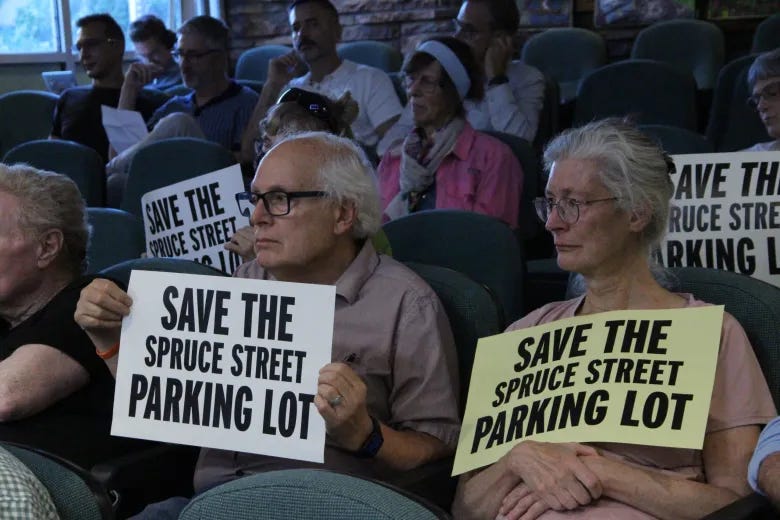
This picture is from a community meeting in Boulder, Colorado. The city council decided to sell a 59-spot parking lot for $5.8 million to a developer who will turn it into a 110-room hotel. This seems like a no brainer, especially in an environmentally city like Boulder. Parking lots are the worse use of public space. It’s reserved space for people’s private property that isn’t even in use! No other object made by man is treated with such reverence. Meanwhile, a hotel is great for a city. It increases the number of tourists who visit. Tourists are wonderful - they spend money without straining city budgets. They stimulate the local economy and spend money at businesses that are generally owned by locals. People don’t go on vacation and then eat at the Olive Garden and shop at Kohls.
Parking lots, on the other, are about the worst way to develop a space. Was the Spruce Street Parking Lot convenient? Yes. When I could get a spot, that was one of my go to places to park in Boulder. But if that lot was full, there was plenty of other parking nearby. But this is some of the highest-value real estate in the country! A company is willing to pay almost $6 million for a tiny parking lot. It’s a no brainer.
There have always been people who were against all change. But now they actually have the power to enforce it. We live in a vetocracy. If any single interest group, and in some case a single person, wants to stop a development, they can. This began as a way to preserve community character and prevent the slash and build attitude that led to quite a bit of destruction in the 1960s and 1970s. Maybe some guardrails are warranted. But when a city can’t build a sidewalk or develop a parking lot, its time to push the pendulum back.