

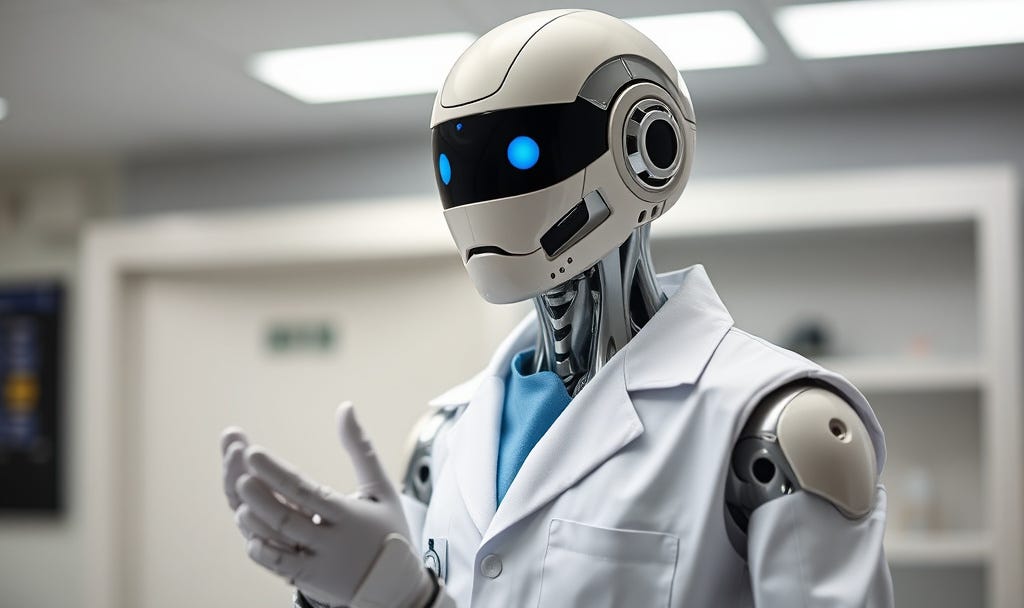
AIs are officially acting as healthcare providers. As reported by Politico, AI is not just transcribing doctor-patient interactions or helping to write notes. The state of Utah has initiated a pilot program in which an AI is renewing medical prescriptions. At the beginning, humans reviewed the renewals. Now, however, patients across the state are able to pick up medication from the pharmacy without any human approving the script.
To be sure, these are baby steps. The prescription process is fairly automated anyway. Patients can request medication refills via the internet, phone, or even text message from their pharmacy. The pharmacy then sends a request to a medical provider, who can then approve the request in less than a minute. It’s a fairly streamlined system that technically has oversight, but is more or less people clicking through the same boxes over and over again. The exact type of behavior, in other words, AI can easily take on.
Of course, not everyone is totally keen on this development. Some people are inherently uneasy about having a computer program making healthcare related decisions. This understandable, and nothing new. People, after all, were against the idea of having elevators go up and down without an attendant. It seemed risky, allowing a machine to decide when to open and shut doors while hanging hundreds of feet off the ground. Having an elevator operator manage the doors and movement of the machine seemed safer to most people. Of course, now it seems anachronistic to even have an elevator operator.
Over the coming decade, similar to elevator automation, people will be uncomfortable with the automation of healthcare. With elevators, people weren’t able to stop the march of progress. After all, companies didn’t want to have to staff elevators 24 hours a day. That gets expensive. Elevator companies recognized what their customers wanted and designed elevators that operated themselves. Everyday people may not have liked it, but the profit motive won out. Today, people don’t think twice about letting a machine whisk them high up into the sky.
What the elevator operators didn’t have was a powerful union. Elevator operators did have a union, which made specious claims about how many people would die if elevators were allowed to operate on their own. About how elevator operators are part of a proud, working tradition, and that automatic elevators will continue to result in the destruction of jobs and destitution of hardworking Americans. About how elevator operators give a personal touch that no machine can ever help to replicate. This wasn’t successful, however, because ultimately there wasn’t the political will to force buildings to have staffed elevators, and the free market is always going to bend towards progress. A weak elevator operators’ union led to technological advancement.
Doctors in the 21st century might not have a powerful union, but they do have one of, if not the most, powerful industry groups in the United States: the American Medical Association (AMA). The AMA has successfully fought for decades to keep prices sky-high. They have limited the number of residencies the federal government will pay for, set up an obscene gauntlet for those who want to become doctors, and successfully lobbied the government to ban most foreign competition. Unsurprisingly, the AMA is not keen on handing over some if it’s duties to machines. At least not any duty that would result in less money for doctors:
In a statement, Dr. John Whyte, CEO and executive vice president at the American Medical Association, said: “While AI has limitless opportunity to transform medicine for the better, without physician input it also poses serious risks to patients and physicians alike.”
One concern is misuse or abuse, including the possibility that people struggling with addiction could try to game automated systems to obtain drugs inappropriately. Another concern is missing subtle clinical red flags or drug interactions that a doctor would catch.
These are serious concerns…when humans are running the system. Automated systems, if designed improperly, can absolutely be gamed. But so too, as we’ve seen to the tune of hundreds of thousands of dead Americans, human systems. How doctors have avoided almost all blowback from the opioid crisis should be studied by public relations firms. Purdue Pharma and the Sackler family were raked over the coals for developing and aggressively marketing OxyContin. Pharmacists were sent to prison. Yet the middle link, the doctors who wrote the prescriptions patients needed to get the drugs in the first place, have largely avoided censure.
If you wanted to make the case for requiring human medical providers, it would be that they will notice addictive tendencies in their patients in a way no robot ever could. The argument would be that without humans, people will figure out how to game the system, and there will be a massive epidemic of overdoses. Lo and behold, that did happen, but not because of computers. The opioid epidemic, the biggest medical scandal in US history, occurred not despite humans, but because of them. The medical professional failed utterly and without qualification. A well-designed automated system never would have allowed millions of Americans to become addicted to opioids. To say otherwise is refuse to learn from an industry’s greatest failure.
It is also ridiculous to argue that “another concern is missing subtle clinical red flags or drug interactions that a doctor would catch.” This is exactly where machines dominate people. It is through AI that we will learn about entirely new negative drug interactions. AI will recognize patterns that no human would ever see. Computers are able to effortlessly sift through millions of patients and drug histories to warn providers of possible pitfalls. No human can come even close.
The AMA is looking out for doctors. As well they should. We shouldn’t expect the AMA to look out for patients any more than we would expect teachers’ unions to look out for students. That’s not the point of the organization. Instead, we need to recognize that the AMA is a special interest group devoted to increasing the incomes of current medical providers. AI poses a threat to those incomes, the same way automatic elevators threatened the livelihoods of elevator operators. Let’s hope progress wins out.
AMA – a reminder that we used to have laws against monopolies.
Also, this post reminds me of Richard Brautigan's poem "All Watched Over by Machines of Loving Grace."