

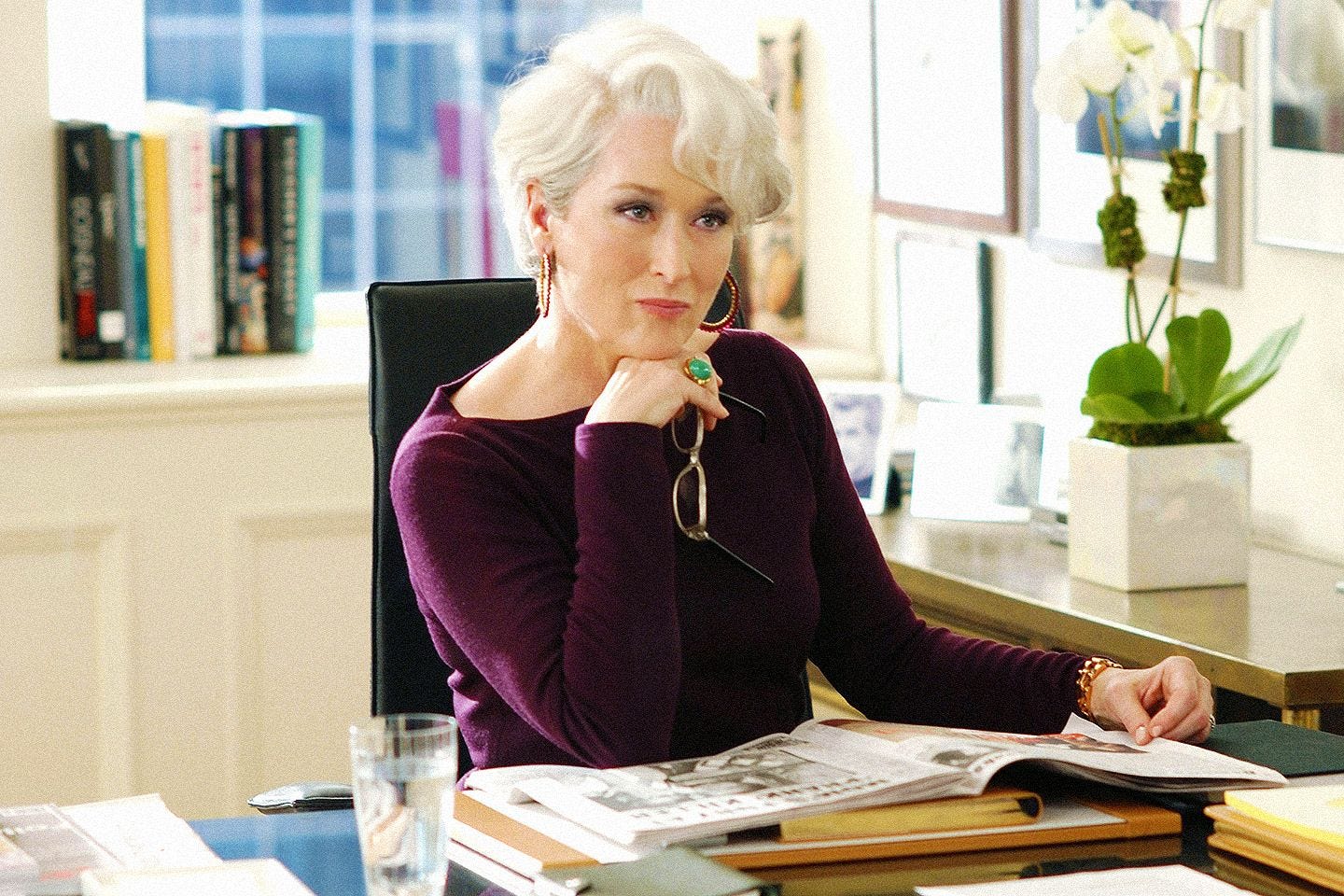
I wouldn’t say I avoided “The Devil Wears Prada”. But I never watched it. I mean, a chick flick about fashion isn’t in my wheelhouse. At the same time, I’ve always had a soft spot for chick flicks — “The Proposal,” not even a stellar example of the genre, is one of my favorites. I wasn’t against watching “The Devil Wears Prada”; it was more that no one ever proposed watching the 2006 film starring Meryl Streep, Anne Hathaway, Emily Blunt, and Stanley Tucci.
Then I got married. One of the wonderful things about tying the knot is that you get to find your new life partner’s movie dead zones. Everyone has incredibly famous, popular movies that, due to a series of unfortunate events, they have never seen. In some cases, it’s far worse: your partner hasn’t even heard of a classic you grew up watching over and over again. I’ll never forget the look on my wife’s face when I asked, “What’s ‘Practical Magic 2’? Was there an original ‘Practical Magic’?”
This was not a smart question.
At any rate, when my wife found out I had never seen “The Devil Wears Prada,” it was a problem that needed to be remedied immediately. Because this discovery occurred during the stage of our marriage defined by rent payments and dinner reservations rather than yardwork and diapers, we watched it that very night.
I loved it. What a fantastic movie. Pitch-perfect acting, witty dialogue, colorful sets, tried-and-true main plot with engaging melodramas throughout, and the magazine editor Miranda Priestly (Streep) is my favorite antihero in all of fiction. It’s both classic fish-out-of-water tale and novel story. The movie has become one of my go-to background movies; the bright colors and constant movement even keep little kids engaged. My main critique is the constant reinforcement that Anne Hathaway’s character, Andy, is somehow not skinny.
The movie is chock-full of memorable scenes and monologues. The most famous, of course, is the one about the cerulean sweater (transcript below):
This… “stuff”? Oh, okay. I see. You think this has nothing to do with you.
You… go to your closet, and you select… I don’t know, that lumpy blue sweater, for instance, because you’re trying to tell the world that you take yourself too seriously to care about what you put on your back, but what you don’t know is that that sweater is not just blue, it’s not turquoise, it’s not lapis, it’s actually cerulean.
You’re also blithely unaware of the fact that, in 2002, Oscar de la Renta did a collection of cerulean gowns, and then I think it was Yves Saint Laurent, wasn’t it? Who showed cerulean military jackets.
And then cerulean quickly showed up in the collections of eight different designers. Then it filtered down through the department stores and then trickled on down into some tragic casual corner where you, no doubt, fished it out of some clearance bin.
However, that blue represents millions of dollars of countless jobs, and it’s sort of comical how you think that you’ve made a choice that exempts you from the fashion industry when, in fact, you’re wearing a sweater that was selected for you by the people in this room… from a pile of “stuff.”
My favorite monologue, however, comes from another magazine employee, Nigel:
Andy, please. Be serious. You’re not trying. You’re whining.
What is it that you want me to say to you? Do you want me to say poor you, Miranda is picking on you? Poor you. Poor Andy. Hmmm? Wake up, Six. She’s just doing her job. Don’y you know you were working at the place that first published some of the greatest artists of the century — Halston, Lagerfeld, De La Renta. And what they did, what they created, was greater than art. Because you live your life in it — well not you, obviously, but some people. You think this is just a magazine? Hmm?
This is not just a magazine. It’s a shining beacon of hope for, oh, I don’t know, let’s say a young boy growing up in Rhode Island with six brothers, pretending to go to soccer practice when he was really going to sewing class and reading Runway at night under the covers with a flashlight.
You have no idea how many legends have walked these halls and what’s worse, you don’t care. Because this place, that people would die to work, you only deign to work. And you want to know why she doesn’t give you a kiss on the forehead and put a gold star on your homework at the end of the day.
Wake up, sweetheart!
What makes both monologues so powerful is that they challenge the viewer’s preconceived notions about the fashion industry. The movie, told from Andy’s perspective, makes the audience initially take her side: that haute couture fashion is worthless. A waste of time, a waste of resources. A hustle performed by wealthy dilettantes bilking the gullible. That would have been an easy movie to make, and a movie that has been made many times.
Instead, we see that those at the apex of the fashion industry view it as a vibrant industry, one that melds form and function, art and practicality. Sure, some of the runway shows may be more about shock and show than anything else. But most of us care about some essence of fashion, as exemplified by Andy choosing a cerulean sweater from the clearance bin, having no idea it was the end result of a haute couture trend from years prior.
The big monologues are interspersed with delightful scenes. One of my favorites is when Andy picks up some sketches from the designer James Holt, played by the underrated Daniel Sunjata. The interaction is quick, but Holt, after learning she is Miranda Priestly’s new assistant, says she must need a drink. He walks her over to the bar, orders her a punch, and, handing her the drink before departing, says, “It’s deadly. Have fun.”
It’s a masterclass in how to be a good host and play industry politics. Holt recognizes that it is worth being on Andy’s good side. She may only be a second assistant, but she’s the second assistant to the most powerful person in fashion: the person in front of the throne, who answers the phones and decides who gets through and who doesn’t. She is someone well placed to grant you a major favor in the future — if she wants to. She’s also young, attractive, and a fresh face, so she’s worth keeping around at a party. At the same time, Holt has a lot of obligations and far more important people to entertain. As a host, he spends exactly the right amount of time engaging in a bit of banter, offering a sincere welcome, getting her a drink in hopes she will stick around, and then politely making clear he has other hosting duties to attend to. The gambit works. Andy doesn’t stay for long, but she does connect with a well-known writer, Christian Thompson, who plays a big role later in the film.
Perhaps what elevates “The Devil Wears Prada” to the next level is the underlying theme of authenticity. As Nigel makes clear, he authentically loves fashion. Andy’s boyfriend, Nate, authentically loves being a chef. Miranda was born to be editor of the magazine. Andy, meanwhile, does not love the fashion industry. The dramatic tension builds as Andy struggles with her lifelong dream of being a legitimate writer while trying to succeed at a job firmly in the part of the journalism industry that most “serious” writers look down their noses at. Nate makes a great point when he accuses Andy of duplicity, making clear that he doesn’t view himself as working for a higher cause: “Andy, I make port wine reductions all day. I’m not exactly in the Peace Corps. I wouldn’t care if you were out all night pole dancing if you did it with some integrity.”
It’s a tough spot for a recent college grad to be in. Andy’s job at Runway Magazine pays the bills. It’s a great stepping stone for someone entering journalism. But it’s fashion. Countless 22-year-olds are in this position right now. They have been told their entire lives to follow their dreams. What do they do when reality hits them in the face instead? Be authentic to themselves? Or sell their soul to make some money?
Put in those terms, the former is clearly preferable. But the happy truth is that one doesn’t have to love one’s job or industry to have an authentic life. One can work in a career that provides financial stability and still find meaning. It’s certainly nice to have a career one loves, but it isn’t necessary. To the contrary, many people have found to their dismay that turning what they love into a career doesn’t make them love the job; it leaves them hating their former passion. The mistake is viewing one’s job as the most important aspect of one’s life. Work to live; don’t live to work.
Andy slowly comes to enjoy the fashion industry. She grows to respect the men and women who devote their lives to designing clothing. When Miranda Priestly pushes Andy’s ethics too far, she quits. But her former boss provides a positive job reference, which leads to a job at a reputable New York newspaper. She gets the opportunity she dreamed of — but only because she was willing to play the game on someone else’s terms.