


On November 6, 2012, Colorado and Washington became the first states to vote to legalize recreational marijuana. It was the first time in history a drug had been legalized by referendum. For years, medical marijuana had been legal to different degrees in several states, but no state had ever made it legal to use marijuana for enjoyment. Since 2012, the dam has broken. Today, the majority of Americans can toke without violating state or local law.
The arguments for marijuana legalization are well established. The ethical arguments are that drug use is a victimless crime and people should be allowed to grow whatever plants they want. The legal arguments are that marijuana prohibition consumes limited resources that would be better allocated to fight violent crime, and that by making marijuana illegal, it creates opportunities for organized crime. The economic argument is that people are going to use marijuana either way, so it might as well be taxed. For decades, marijuana advocates used reason and persuasion to advocate for their cause. Over the decades, they slowly won people over. People from across the ideological spectrum began to support marijuana legalization, even if they weren’t users. Mainstream media also began to support legalization. This led to the new status quo.
Today, some of those groups are feeling a bit of buyer’s remorse.
Simple economics suggests that if a drug is legalized, demand will likely increase. By legalizing a product, the risks of purchasing it have been reduced. Even if the price in dollars stays the same, or even rises, not having to worry about going to jail for using a plant is going to increase demand. However, the demand for drugs is thought to be inelastic. That is, the demand is going to be mostly the same regardless of cost. People who want to do drugs are going to do so. The thinking was that under the old regime, there weren’t a lot of people who wanted to use marijuana but didn’t because it was illegal. By legalizing the drug, the market can be brought out of the shadows, but demand won’t increase much because everyone who wants to use already does.
With hindsight, it looks marijuana is considerably more elastic than originally thought. Over a decade after recreational legalization began, surveys consistently show that marijuana use has gone up dramatically. Anecdotally, Americans have begun to notice the same thing. It is normal to smell marijuana smoke in any major city where the drug is legal. The results from a recent study are striking. First, the rate at which people use marijuana has gone up dramatically over the last 25 years:
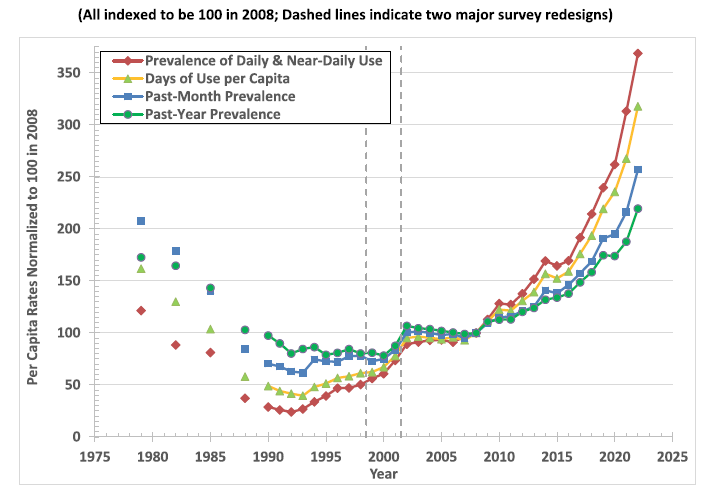
A few trends stand out. First, it is clear that the war on drugs, contrary to popular belief, appears to have worked to some degree. Throughout the 1970s and 1980s, those using marijuana anywhere from daily to at least once in the past year declined until the early 1990s. Now there may be some measurement error here, especially as the crackdown on drugs incentivizes people to not acknowledge drug use. Still, the trend is interesting. Since the 1990s, however, and especially since 2010, marijuana use has skyrocketed. It’s now higher than at any point since data collection began. Those who have used marijuana in the past month has more than doubled, those reporting daily or near-daily marijuana use has more than tripled. All in less than 15 years.
Also troubling is that the relative intensities have flipped. From the 1970s until the 2000s, annual users were more common than monthly users and monthly users were more common than daily users. This points to a drug that most users take in moderation, with few addicts. In the 21th century, however, the paradigm flipped. Now there are more daily users than monthly users and more monthly users than annual users. And the gaps are widening at a fast clip. Now, the norm is for a marijuana user to be at least a near-daily user, defined as having used marijuana at least 21 days in the previous month. Translating it into numbers, in 1999, roughly 4 million Americans reported using marijuana 1-3 days in the last month. Now, it is 11 million. About 2.5 million people in 1999 used marijuana at least 21 days a month. It is now 18 million. That’s more than one in every 20 people.
Equally striking is when marijuana is compared to alcohol. In 2005, the ratio was 3:1 in favor of alcohol. For the first time ever, there are now more daily or near-daily users of marijuana:
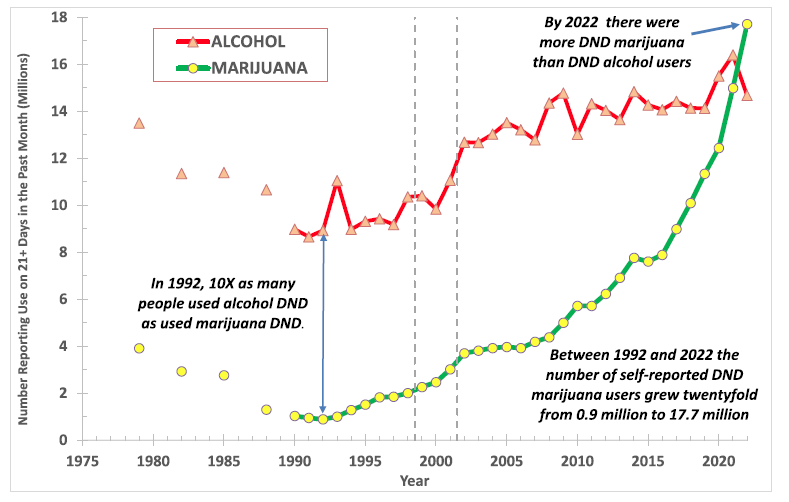
It turns out those against legalization were correct: it has turbocharged demand. Far from being an inelastic drug with a mostly fixed demand, the demand for marijuana is heavily dependent on external factors. What got overlooked was not the problem of illegality - it still seems unlikely there were many people who wanted to use marijuana but refrained because it was illegal. Rather, legality changed the bigger hurdle: accessibility. Acquiring marijuana used to have significant transaction costs. In an age when millions of items can be ordered to your door with the click of a button, procuring some bud used to be a cumbersome process, involving word of mouth, phone calls, and often a trip to an unsavory part of town. Today, those accessibility issues are largely gone. Allowing people to go to the corner pot store made the drug much more popular than most had envisioned.
As the saying goes, the haters said this would happen. And they were correct. Honestly great call from the haters.
What to do going forward? First, we shouldn’t go back to the old regime. Devoting significant resources to stop people from consuming a plant is still as absurd as it ever was. However, there are options for harm reduction. First, and counterintuitively, marijuana should be legalized at the federal level. The Trump administration has taken steps in the right direction by urging the federal bureaucracy to reschedule marijuana as a Schedule III drug, rather than the most extreme Schedule I. By making marijuana legal entirely, it will remove its status in the grey area. Normally, we would expect to see significant research, public messaging, and standards developed around a legal drug. Because marijuana is still illegal at the federal level, that isn’t happening. Grant money is hard to come by, national ad campaigns about the dangers of marijuana are absent, and there aren’t any standards.
Second, the media needs to updates it’s priors. A recent New York Times article does just that, discussing how America has a marijuana problem. A lot of other media outlets, having embraced marijuana legalization and afraid of a return of carceral penalties for users, have been hesitant to do so. Even the NYT article states, “We want to emphasize that occasional marijuana use is no more a problem than drinking a glass of wine with dinner or smoking a celebratory cigar.” This is, frankly, not true. A glass of wine with dinner is nothing like occasional marijuana use. A typical adult can easily have a glass of wine with dinner and drive home without being the least bit impaired. Those who consume marijuana are rarely, if ever, showing such temperance. As Barack Obama famously said when asked if he inhaled when using marijuana as a young man, “That was the point.” As many have remarked, this isn’t your father’s weed. THC levels are much higher, sometimes exponentially higher, than the weed of the 1980s. Using marijuana today means being mentally impaired for hours. That isn’t to say it turns your brain into a fried egg, but the accurate comparison to a joint is a full bottle of wine, not a single glass.
Third, standards are needed. Research is needed. What are the physical and mental health risks of daily marijuana use? What is the best treatment for those suffering from addiction? What should be considered a single THC dose? Answers will not be discovered overnight. Researchers have examined alcohol for decades, and until recently, many thought dehydration was the primary cause of hangovers. Today we know better. Similar research into THC will take years and needs to start now. Marijuana is here to stay. It’s time to decide how it should be governed before too much addiction leads to significant societal problems.
Moreover, I'm old enough to remember people insisting that pot wasn't physically addictive. In the last 4-5yrs. I've smoked regularly enough to confirm that – yes, it is. Quite so. It ain't heroin, but you will experience many of the same withdrawal symptoms, albeit not at the same intensity. For me, it takes about a month after daily smoking for the symptoms to subside, and they are not pleasant.
This kind of environment – it's all drugs – calls for a new kind economic thinking: instead of "as much as I can get for as little I can pay" (i.e. the big-box model, or "economics"), one ought to invert that into "as little for as much as I can afford." In other words, let quality & intention, not just limited means, moderate your pursuits.