

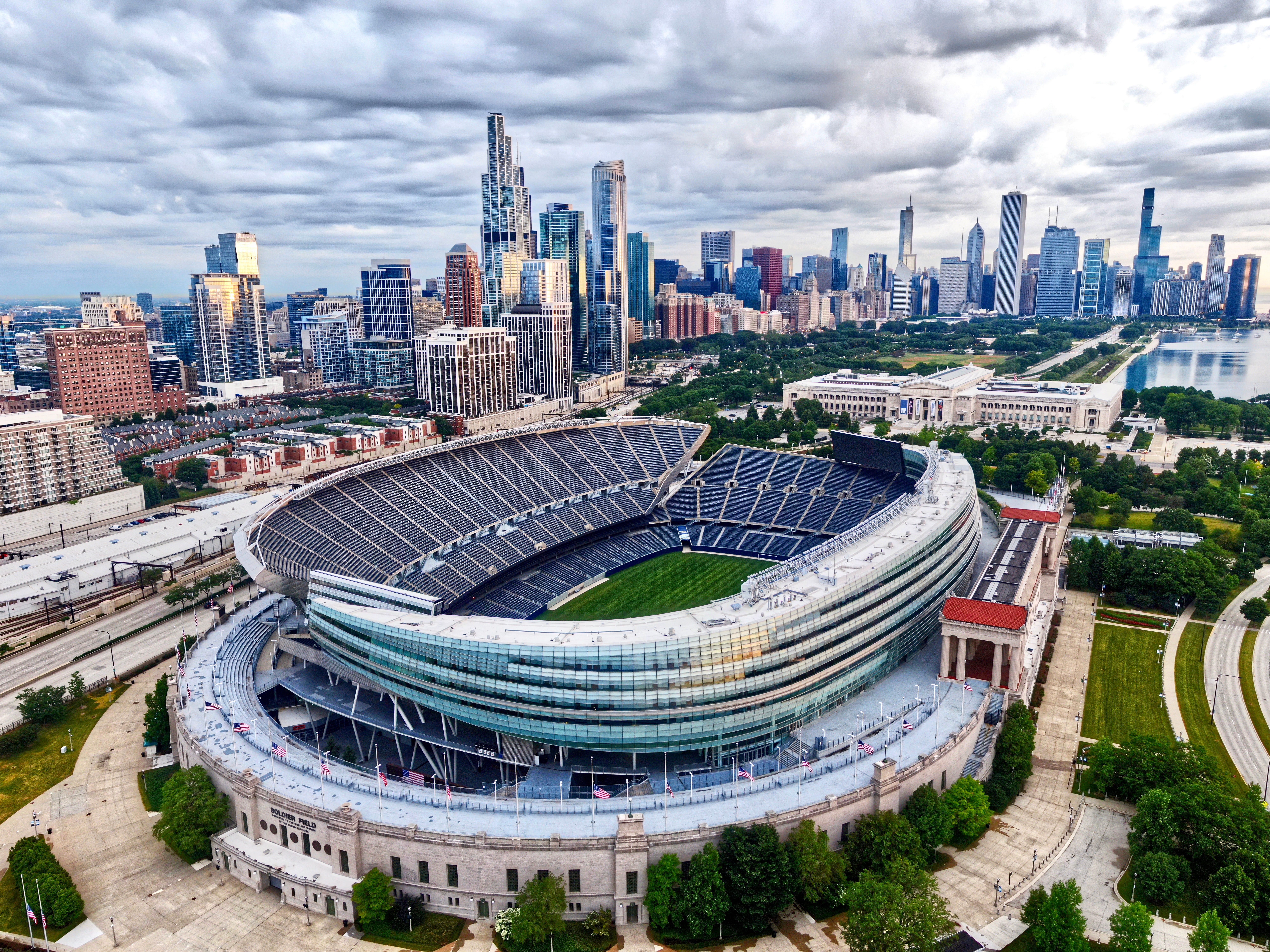

On June 5, the Chicago Bears made a major announcement: they were leaving the City of Chicago and State of Illinois for nearby Hammond, Indiana. The announcement was not a surprise. For years the Bears had been agitating for a new stadium. Their current stadium, Soldier Field, was renovated in 2003, but leaves much to be desired in today’s NFL. Notably, it is an open-air venue, not the best choice for a team that plays in one of the country’s coldest major cities. In 2023, the Bears purchased land in the Chicago suburb of Arlington Heights and considered building a stadium there. Then they asked the City of Chicago to build a new stadium near their existing venue on the Chicago lakefront. Neither project was getting the legal terms or public financing they requested, so the Bears began to look farther afield.
They settled on the town of Hammond, Indiana. Hammond may be in an entirely different state, but it’s still part of the Chicago metropolitan area. The town line is less than 20 miles from Soldier Field and has easy highway access. Unfortunately, Hammond is a byword for industrial decay. It may not quite get the bad press of nearby Gary, Indiana, but both are textbook examples of blight and post-industrial malaise. Much of the city would be considered a brownfield if it were ever built on.
Chicago Bears fans were furious. The Bears have always played in Illinois and been in Chicago for over a century. Despite their lack of on-field success, they are the most beloved franchise in the city. More than the Cubs, one of the most storied franchises in all of sports. More than the Bulls, the team that put together arguably the most dominant sports dynasty in history in the 1990s. Chicagoans love the Bears. The team brings the city together more than anything else, except maybe a revulsion to putting ketchup on hot dogs. Every spring Chicagoans divide between the Cubs and the White Sox. Every fall, they come together over a shared passion for the Bears.
The dispute over the Bears’ next stadium revolves around money. Despite the immense wealth the NFL generates, most stadiums teams play in are unique in that they are not owned by the team. Instead, cities usually pony up hundreds of millions or billions of dollars, build a stadium, and then lease the stadium to a local NFL team under favorable terms. This is exactly what the Bears currently have. In 2003, Soldier Field reopened after a multiyear, $600 million renovation, over $400 million of which was paid for by the taxpayer. The Bears signed a 30-year lease for $7 million a year. Not a bad deal for a franchise valued at $8 billion dollars.
Now that the lease is coming to an end, the Bears want a second new stadium. The State of Illinois, understandably, doesn’t want to pay for one. Given that renovated Soldier Field is less than 25 years old, it seems ridiculous to put the public on the hook for even more money to support a franchise worth billions of dollars. The Bears then pursued building a private stadium in the suburbs, but don’t want to pay property taxes on it. It looked like the Illinois legislature was close to passing a bill granting the Bears tax relief, but ultimately it never came to a vote. Indiana, meanwhile, quickly passed a bill that would provide up to $1 billion in funds if the Bears move to Hammond.
Public subsidization of sports stadiums is an interesting issue. Both sides of the argument have good points. Critics of the approach correctly point out that this is a terrible use of public funds. Economic studies have consistently found that the amount of money spent is not recovered by increased economic gains. Teams like to claim that by picking up the tab, states will later make additional tax revenue that more than covers initial expenditures, but that is generally not the case. It’s also a zero-sum game. Despite high demand, increased popularity, and ticket prices through the stratosphere, public financing doesn’t increase the number of sports franchises. The NFL currently has 32 teams, most of which play in publicly-owned stadiums. If none of those stadiums were subsidized by the taxpayer, the number of NFL teams would still probably be 32. This is just corporate welfare of the highest order. Teams will exist either way; they just go to whoever is willing to give them the most money.

On the flip side, when it comes to corporate welfare, sports teams are sometimes unfairly singled out. States and cities give tax incentives all the time to preferred businesses, but it usually doesn’t attract as much attention as when it’s a sports franchise. Illinois has a long history of this. In 2001, the state gave Boeing $61 million dollars in tax subsidies to move its corporate headquarters to Chicago. This would bring 500 jobs to the city. This was not a good deal. First, Boeing used some creative accounting to reach those promised 500 jobs. Second, as soon as the subsidies ended, Boeing moved its corporate headquarters to Virginia. Oops.
The Boeing deal, however, is chump change compared to the deal Illinois offers Amazon. A decade ago, Amazon announced it was building a second headquarters, and announced a national competition where cities could make their case. States tripped over themselves trying to give one of the largest companies on Earth as much money as they could. Illinois was willing to give this corporate behemoth an astonishing $1.4 billion in tax credits. Amazon, of course, eventually announced it would split the new headquarters between New York City and the DC area, confirming suspicions that this was the plan all along and they just wanted as much money as possible.
Despite the bad economics of building the Bears a new stadium or letting them build their own tax-free one in the suburbs, those who support public subsidies have a point. If Chicago and Illinois are willing to hand over millions of dollars to other private companies, why not do it for sports teams? They may be private entities, but so too are many museums. They may be for-profit, but they are an important part of the fabric of a city. Non-sports fans may scoff, with some justification, at the loyalty fans have to their sports teams. But the reality is sports play a key unifying role in many cities. Subsidizing them isn’t the worst idea in the world.
This is doubly true in a place like Chicago. As Chicagoans constantly complain, America’s second city is terrible with money. So is the state. Government employees get sweetheart pension deals and move to Florida. Millions are spent on schools where little learning is taking place. Corrupt construction deals have been the norm for decades. As long as billions of dollars are being spent on things with no tangible benefit, why not lavish some money on organizations that are loved throughout the city? It’s a strange argument, but one that makes a depressing sort of sense.
Really, this is a problem that collective action could easily solve. Teams will not go bankrupt if cities and states stop subsidizing them. If Congress passed a national law banning the subsidization of sports franchises the problem would disappear. Teams would build their own stadiums, like SoFi Stadium in California. Teams would probably move less often and play in older buildings. What a wonderful dream, but a dream it will stay.
I enjoy this story (GPG)
Are you suggesting that state and city governments and voters require the federal government to nanny state them out of making stupid agreements with for profit businesses? Interesting argument…